
Unlock Your Brain’s Superpower: The Surprising Science Behind Speed Reading
Why Speed Reading Isn’t Just About Speed—It’s About Transforming Your Mind

Why Speed Reading Isn’t Just About Speed—It’s About Transforming Your Mind
Have you ever felt overwhelmed by the sheer volume of reading in your life? Whether it’s endless work emails, textbooks, or the latest must-read non-fiction, most of us wish we could read faster—and actually remember what we read. But what if the secret to speed reading wasn’t just about turning pages faster, but about retraining your brain to process information in a fundamentally different way?
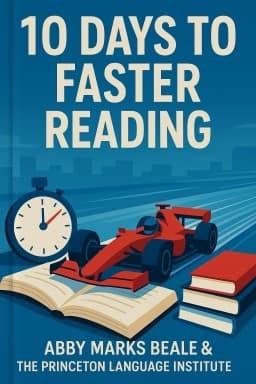
Let’s start with a misconception: Most people think speed reading is a gimmick, reserved for savants or the ultra-disciplined. In fact, Abby Marks Beale, author of 10 Days to Faster Reading, argues that anyone can learn to read faster by understanding and applying a handful of science-backed techniques. The first step? Realizing that your current reading speed is largely the product of habits formed in childhood—habits that can be gently unlearned.
Why We Read So Slowly
Most adults read at about 200–300 words per minute, a pace dictated by subvocalization (the habit of silently pronouncing every word) and regression (rereading lines out of uncertainty). Neuroscience shows that the brain can process words far faster than the voice can speak them, but our habits act like a speed limiter on a sports car. Breaking these habits starts with awareness. Try this: next time you read, notice your inner voice. Can you turn down its volume, or even hum or chew gum to distract it? This simple experiment often unlocks a surprising jump in speed.
The Power Tools: Pacers and Eye Span
One of the most powerful tools in speed reading is the humble pacer—a finger, pen, or card you move under the text as you read. This isn’t just a trick; studies show that guiding your eyes with a pacer reduces regression and keeps your focus moving forward. Over time, you can train your eyes to take in larger ‘chunks’ of text, expanding your eye span from single words to phrases or even whole lines. This isn’t about skimming or missing details—it’s about using your brain’s natural pattern recognition to process more with less effort.
Comprehension and Retention: The Real Test
Does reading faster mean you’ll remember less? Not if you use the right strategies. Previewing a chapter before diving in—by scanning titles, subheads, and first sentences—gives your brain a roadmap, making it easier to absorb and recall information. Taking margin notes, highlighting key words, and pausing to summarize after each section are proven methods for locking in learning. In fact, research shows that comprehension often improves as you read faster, because your mind stays more engaged and less prone to distraction.
Real-World Results: Who Benefits from Speed Reading?
From students cramming for exams to executives buried in reports, speed reading has helped countless people reclaim hours each week. Case studies in Beale’s books describe readers doubling or even tripling their speed in just a few weeks, with no loss in comprehension. The key is consistent practice—short daily sessions, using a variety of materials, and tracking your progress.
The Joy of Reading, Rediscovered
Perhaps the greatest benefit of speed reading is the return of joy and curiosity. When reading becomes less of a chore and more of an adventure, you’re more likely to read for pleasure, explore new topics, and keep learning for life. Speed reading is not about racing to the end—it’s about making every page count, and every idea stick.
Ready to unlock your brain’s superpower? Start today, and let each book become a new journey of discovery.
References: 10 Days to Faster Reading by Abby Marks Beale, The Complete Idiot’s Guide to Speed Reading, Blinkist Magazine, PersonalMBA review, and modern neuroscience research on reading habits.
Want to explore more insights from this book?
Read the full book summary