
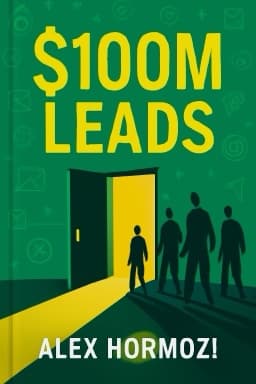
Unlocking Explosive Growth: How $100M Leads Can Revolutionize Your Business
Discover the secrets behind generating millions of leads and scaling your business beyond limits.

In the fast-paced world of entrepreneurship, generating high-quality leads consistently is the lifeblood of any thriving business. Alex Hormozi’s book, $100M Leads, distills years of experience into a clear, actionable framework designed to help business owners attract, engage, and convert leads at an unprecedented scale.
What is a Lead, Really? Hormozi challenges the conventional notion that leads are just contacts. Instead, he defines leads as engaged prospects who show genuine interest. This distinction is crucial because it shifts the focus from quantity to quality, ensuring your marketing efforts target those most likely to convert.
Lead Magnets: The Gateway to Engagement The book introduces three types of lead magnets that work like magic: revealing hidden problems, offering free samples or trials, and providing one step of a multi-step process. For example, a free website speed test reveals a problem the prospect didn’t realize, creating urgency for a solution. These magnets serve as low-commitment, high-value offers that nurture trust and open doors for further interaction.
The Core Four Advertising Methods Hormozi categorizes advertising into four fundamental methods based on audience warmth and communication style: warm outreach (one-to-one), posting free content (one-to-many to warm audiences), cold outreach (one-to-one to strangers), and paid ads (one-to-many to cold audiences). Mastering these ensures comprehensive coverage of all potential lead sources.
Consider warm outreach as the most reliable method; a personalized message to a friend or past customer often yields higher conversion than broad paid ads. But paid ads, when crafted with compelling offers and precise targeting, can scale lead flow massively.
Scaling: More, Better, and New To grow lead flow, Hormozi advocates the 'Rule of 100'—taking 100 advertising actions daily for 100 days to build momentum. Beyond volume, continuous testing and optimization of funnel constraints improve conversion rates. When growth plateaus, expanding to new platforms or ad placements refreshes the pipeline.
Leverage and Automation: Multiplying Your Impact The book’s most powerful insight is leveraging others—customers, employees, agencies, and affiliates—to become lead getters, combined with automating repetitive tasks. This approach transforms your business from a solo effort into a self-sustaining lead machine, capable of generating tens of thousands of leads without proportional increases in workload.
Measuring What Matters Hormozi stresses tracking key metrics such as cost per lead and conversion rates to identify bottlenecks and optimize spend. Continuous measurement and small iterative tests turn guesswork into data-driven decisions, ensuring every dollar invested yields maximum return.
The $100M Leads Plan This plan integrates all these elements into a simple, actionable roadmap that balances core advertising, leverage, and automation. Simplicity is key to execution—overcomplicated plans stall progress, while clear, focused strategies drive momentum and growth.
Mindset: Confidence and Persistence Finally, the journey is as much mental as tactical. Persistence through setbacks and confidence born from mastery fuel sustained success. Hormozi encourages embracing challenges and viewing failures as stepping stones, creating a resilient foundation for long-term growth.
By applying these principles, businesses have reduced acquisition costs by up to 70%, doubled lead quality, and built scalable systems that work 24/7. The $100M Leads framework is not just a book—it’s a blueprint for transforming your business and unlocking limitless growth potential.
For further insights, this blog also draws on summaries and reviews from sources such as DannyBooboo.com, GregFaxon.com, and AndrejTheFreelancer.medium.com, enriching the discussion with diverse perspectives and examples. 1 , 2 , 3
Want to explore more insights from this book?
Read the full book summary