
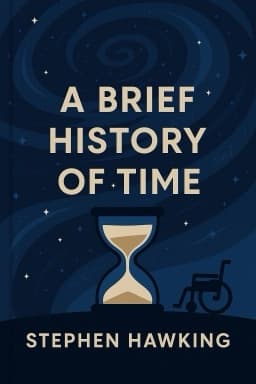
5 Mind-Blowing Secrets About the Universe From 'A Brief History of Time'
What Stephen Hawking Reveals About Reality, Time, and Everything in Between

If you’ve ever looked up at the night sky and wondered what it all means, you’re not alone. In 'A Brief History of Time,' Stephen Hawking invites us on a journey where every answer sparks a dozen new questions. Here are five of the most jaw-dropping revelations from the book that will change how you see the universe.
1. The Universe Is Expanding—And So Is Our Imagination
Centuries ago, people believed the universe was static and eternal. That all changed with the discovery that galaxies are moving away from us, their light stretched into red hues—a phenomenon called redshift. This means space itself is expanding, and if you rewind the cosmic clock, everything converges to a single, fiery beginning: the Big Bang. This isn’t just a theory; it’s supported by the faint afterglow of the cosmic microwave background, a snapshot of the universe as a newborn.
2. Black Holes Aren’t Completely Black
Black holes are the universe’s ultimate enigmas—regions where gravity is so strong that not even light can escape. But Hawking made a revolutionary prediction: black holes actually emit faint radiation, now known as Hawking radiation. Over unimaginable timescales, this means they can gradually evaporate and disappear. It’s a discovery that links quantum mechanics, thermodynamics, and gravity, and suggests that even the darkest places in the universe are not eternal prisons.
3. Time Isn’t What You Think
Time seems simple—it ticks forward, always at the same pace. But according to Einstein’s relativity, time is woven together with space, and both can bend and stretch. Gravity slows time down, so clocks tick more slowly near massive objects. This isn’t science fiction; it’s measured every day by GPS satellites, which must account for the difference in time between space and Earth. Hawking also explores the tantalizing possibility of time travel—at least in theory—by using wormholes or the warping of space-time.
4. The Quantum World Is a Dance of Probabilities
At the smallest scales, certainty vanishes. Particles can be waves and waves can be particles, and their behavior is governed by probabilities, not certainties. The famous Heisenberg uncertainty principle means we can never know both the position and speed of a particle exactly. The universe, at its core, is not deterministic but a place of endless possibilities.
5. We May Be Close to a Theory of Everything
Hawking’s ultimate mission is to find a single, unified theory that explains all forces and particles in the universe. While great progress has been made—like the unification of electromagnetism and the weak nuclear force—gravity remains the final piece of the puzzle. String theory offers hope, suggesting that everything is made of tiny, vibrating strings, but the journey is far from over. The search for unity is as much about philosophy and wonder as it is about equations.
Conclusion: You Are the Universe, Wondering About Itself
Perhaps the greatest secret Hawking shares is that the universe is not just out there—it’s within us. Our curiosity, our questions, and our capacity for wonder are what make us part of the cosmic story. As Hawking famously said, 'Remember to look up at the stars and not down at your feet.' So keep asking, keep exploring, and let these mind-blowing secrets inspire your own journey through space and time.
Want to explore more insights from this book?
Read the full book summary