
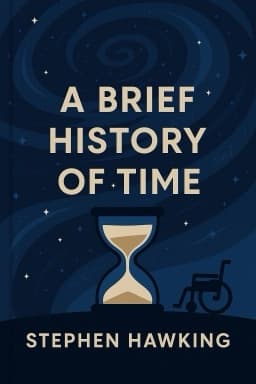
The Ultimate Beginner’s Guide to 'A Brief History of Time'
Everything You Need to Know Before Reading Stephen Hawking’s Classic

Are you new to cosmology or just curious about what makes Stephen Hawking’s 'A Brief History of Time' so legendary? You’re in the right place. This guide breaks down the book’s main ideas, helping you get comfortable with the basics before you dive in.
Space and Time: The Dynamic Duo
Forget the old idea of space as a static backdrop and time as a universal clock. Hawking explains how Einstein showed they’re part of a single, flexible fabric—space-time—that bends and ripples in response to mass and energy. This is the foundation for understanding everything else in the book.
The Expanding Universe
Hawking describes how astronomers discovered that galaxies are moving apart, meaning the universe is getting bigger. This leads to the big bang theory, which says the universe had a beginning—and possibly an end.
Black Holes and Quantum Surprises
Black holes are more than cosmic traps—they’re places where the known laws of physics break down. Hawking’s work on black hole radiation changed the way scientists think about these objects, linking them to quantum mechanics and the fate of information.
The Quest for a Unified Theory
One of the book’s main themes is the search for a 'theory of everything'—a single set of laws that explains all the forces and particles in the universe. While scientists have made progress, especially with the unification of some forces, the puzzle is far from complete.
Why Hawking’s Book Matters
'A Brief History of Time' changed the way science is communicated. Hawking’s blend of clarity, humor, and humility made complex ideas accessible to millions. Whether you want to understand black holes or just impress your friends, this book is the perfect place to start.
Want to explore more insights from this book?
Read the full book summary