
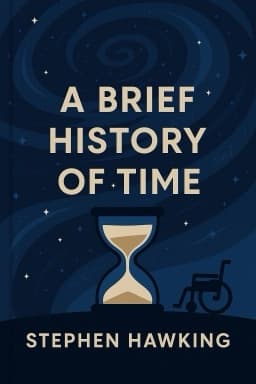
Time Travel, Black Holes, and Other Mind-Bending Ideas from Stephen Hawking
How Hawking’s Book Challenges Everything You Thought You Knew About Reality

What if you could fall into a black hole and emerge in another universe? What if time itself could run backward, or split into loops and paradoxes? These aren’t just science fiction fantasies—they’re real questions at the heart of Stephen Hawking’s 'A Brief History of Time.' Let’s dive into some of the book’s wildest ideas and see how they might reshape our understanding of reality.
Black Holes: Not Just Cosmic Vacuums
Black holes are more than just gravitational traps. Hawking showed that they radiate energy, thanks to quantum effects at their event horizons. This means black holes can slowly evaporate, challenging the old notion that nothing can escape their pull. Even stranger, the fate of information that falls into a black hole remains one of the biggest mysteries in physics—does it get destroyed, or is it somehow preserved in the radiation?
Time Travel: Not Impossible, Just Unlikely
Hawking discusses the theoretical possibility of time travel, using concepts like wormholes—tunnels through space-time that could connect distant points in the universe or even different eras. While the laws of physics don’t explicitly forbid time travel, the practical challenges are enormous. Still, the idea opens up fascinating questions about causality, paradoxes (like meeting your past self), and the ultimate nature of time.
Quantum Weirdness: Where Reality Gets Fuzzy
On the quantum scale, particles can exist in multiple states at once, and events are governed by probabilities rather than certainties. Hawking explains how this fuzzy logic leads to phenomena like quantum tunneling, where particles can pass through barriers they shouldn’t be able to cross. This is not just a theoretical curiosity—it’s the basis for technologies like quantum computing.
The Universe Without Boundaries
One of Hawking’s most radical proposals is the 'no boundary' condition, suggesting that the universe may be finite but without edges—like the surface of a sphere. This idea helps resolve paradoxes about the beginning of time and avoids the need for a singular, infinitely dense starting point. It’s a concept that brings together quantum mechanics, relativity, and cosmology in a single, elegant vision.
Conclusion: Why These Ideas Matter
Hawking’s genius wasn’t just in his technical skill, but in his ability to make the wildest ideas seem plausible—and to show why they matter. By exploring black holes, time travel, and the quantum world, he invites us to question our assumptions and embrace the unknown. The universe, he suggests, is far stranger and more wonderful than we ever imagined—and the journey to understand it is only just beginning.
Want to explore more insights from this book?
Read the full book summary