
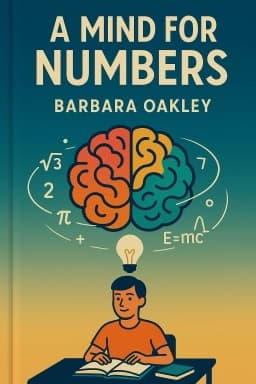
Unlocking Your Brain’s Hidden Potential: The Science-Backed Secrets from 'A Mind for Numbers'
Discover how anyone can master math, science, or any tough subject with proven brain techniques from Barbara Oakley’s bestseller.

How Anyone Can Master Math, Science, or Any Tough Subject
Imagine standing at the edge of a vast forest, each tree representing a new concept, formula, or skill. For many, this forest—especially when it comes to math and science—seems impenetrable. But what if you had a map, a toolkit, and a guide who once struggled just as you do now? That’s exactly what Barbara Oakley offers in 'A Mind for Numbers.' Her personal story, from failing math in high school to becoming a professor of engineering, is a beacon for anyone who has ever doubted their ability to learn.
At the core of Oakley’s message is the science of neuroplasticity. The brain is not a static organ with fixed abilities; it’s a dynamic, ever-changing network that grows and adapts with practice. This means that the old belief in 'math people' and 'non-math people' is simply wrong. Anyone can develop the skills needed to excel, given the right strategies and mindset.
Oakley introduces two modes of thinking: focused and diffuse. Focused mode is like a laser, zeroing in on details and step-by-step problem-solving. Diffuse mode, on the other hand, is more like a lantern, casting a broad light and allowing for creative connections. The magic happens when you alternate between these modes—intense study sessions followed by breaks, walks, or even naps. This dance between focus and relaxation is where breakthroughs are born.
But how do you make sense of the overwhelming amount of information? Oakley’s answer is 'chunking.' By grouping related ideas into meaningful units, you free up mental space and make recall effortless. Think of learning to drive: at first, every action is conscious and clumsy, but with practice, the steps merge into a single, fluid skill. The same principle applies to equations, vocabulary, or any complex discipline.
Of course, the path isn’t always smooth. Procrastination is the enemy of progress, but Oakley demystifies it as a habit loop—cue, routine, reward—that can be rewired. She champions the Pomodoro Technique: work in short, focused bursts, then reward yourself with a break. This not only makes daunting tasks manageable but also trains your brain to see learning as a series of small wins.
Habits are the scaffolding of success. By anchoring study sessions to existing routines and celebrating even minor achievements, you build momentum. Oakley emphasizes the power of belief and community—when you share your goals and progress with others, motivation soars.
Finally, Oakley urges readers to reflect on their learning journey. Teaching others, reviewing progress, and staying curious ensures that knowledge isn’t just acquired but retained and enriched over time. In a world that never stops changing, the ability to learn is the greatest gift you can give yourself.
Whether you’re cramming for exams, switching careers, or simply seeking to sharpen your mind, 'A Mind for Numbers' is more than a study guide—it’s a manifesto for lifelong growth. The forest of learning is vast, but with Oakley’s insights, you’ll find it not just navigable, but beautiful.
Want to explore more insights from this book?
Read the full book summary