
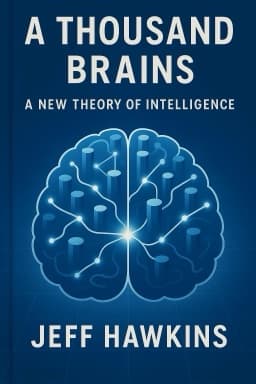
You Won’t Believe How Your Brain Actually Works: The Thousand Brains Revolution
Unlocking the Hidden Power of Your Mind—And Why It Changes Everything About Intelligence

Unlocking the Hidden Power of Your Mind—And Why It Changes Everything About Intelligence
Imagine waking up one morning to discover that your mind isn’t a single, unified entity, but a bustling metropolis of thousands of independent thinkers. This isn’t science fiction—it’s the core of Jeff Hawkins’ Thousand Brains Theory, a radical new understanding of intelligence that’s shaking up neuroscience and artificial intelligence alike. The neocortex, that wrinkled outer layer of your brain, isn’t just a sheet of gray matter. It’s a collection of about 150,000 cortical columns, each acting like a mini-brain, learning, predicting, and modeling the world in parallel.
This theory explains why the neocortex looks so uniform across its regions—whether it’s processing vision, touch, or language, the same basic algorithm is at work. Each column builds its own reference frames, mapping everything from the curve of a coffee cup to the structure of a political idea. When you reach for an object, dozens of columns predict what you’ll sense, and your perception is the result of a democratic vote. If most columns agree, you experience reality as stable and familiar. If there’s disagreement—perhaps you feel a chip on the cup or see a friend in an unexpected place—your brain pays attention, updates its models, and learns.
The Thousand Brains Theory isn’t just a curiosity—it’s a game-changer. It explains why we can adapt to new situations so quickly, why false beliefs can persist when columns reinforce each other’s mistakes, and why movement—physical or mental—is essential for learning. The implications stretch far beyond biology. AI researchers are now looking to the brain’s architecture to build machines that learn, adapt, and reason more like humans. Instead of brittle, narrow programs, the future of AI may be built from thousands of semi-independent modules, each learning and predicting in parallel.
But with great power comes great responsibility. As we build smarter machines, we must also consider the risks—AI without brain-inspired safeguards could behave unpredictably or even dangerously. Understanding how our own minds work isn’t just a scientific quest; it’s essential for shaping a future where technology serves humanity wisely. The Thousand Brains Theory is more than a theory—it’s an invitation to rethink what it means to be intelligent, to learn, and to choose our path forward.
So next time you notice something new or surprising, remember: it’s not just one brain at work, but a thousand, collaborating, debating, and learning together. That’s the real magic inside your head.
Want to explore more insights from this book?
Read the full book summary