
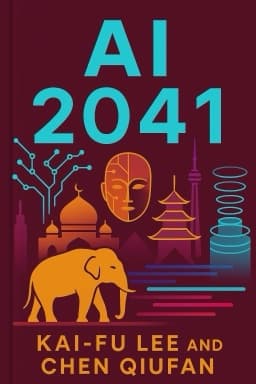
AI 2041: The Mind-Blowing Future of AI You Never Saw Coming!
Discover the surprising ways AI will reshape our world by 2041, from deep learning breakthroughs to ethical dilemmas and human renaissance.

Artificial intelligence is no longer the stuff of science fiction—it’s rapidly becoming the defining force of our century. In the groundbreaking book AI 2041, Kai-Fu Lee and his co-author present ten vivid stories fused with expert analysis, painting a detailed picture of how AI will transform our world by the year 2041. This blog will take you on a journey through the most captivating insights from the book, enriched with real-world examples and emerging trends shaping our future.
The Heart of AI: Deep Learning’s Rise and Reach
At the core of modern AI is deep learning, a technology inspired by the human brain's neural networks. Although theorized decades ago, deep learning only recently exploded into practical use thanks to the availability of massive datasets and powerful computing resources. This technology enables AI systems to recognize patterns in images, language, and data, driving innovations from personalized insurance premiums to medical diagnoses. However, deep learning optimizes narrowly defined objectives, which can sometimes lead to unintended social consequences, such as reinforcing biases or discouraging certain personal choices. Understanding this foundational technology is key to grasping AI’s dual power and pitfalls.
When AI Sees: The Double-Edged Sword of Computer Vision and Deepfakes
AI’s ability to 'see' through computer vision has revolutionized industries but also created new challenges. Convolutional Neural Networks enable machines to process complex images and videos, while Generative Adversarial Networks (GANs) have given rise to deepfakes—highly realistic but fake visual content. These technologies can manipulate public opinion and disrupt social trust, but they also power creative applications like film restoration and medical imaging. The ongoing battle between deepfake creators and detectors exemplifies the broader ethical challenges AI presents.
Speaking AI: How Natural Language Processing is Revolutionizing Education
Natural Language Processing (NLP) enables AI to understand and generate human language, transforming communication and learning. Self-supervised learning techniques allow models to grasp language patterns without extensive human labeling, leading to powerful AI tutors that personalize education, especially for neurodiverse children. While these models lack true consciousness, their conversational abilities foster engagement and emotional support, complementing human teachers and opening new educational horizons.
Work Disrupted: Navigating Job Displacement and New Opportunities
AI’s automation of routine tasks threatens many traditional jobs but also creates new roles requiring creativity and empathy. The 3Rs framework—Relearn, Recalibrate, Renaissance—guides individuals and societies to adapt by acquiring new skills, collaborating with AI, and embracing a creative renaissance. Universal Basic Income (UBI) is debated as a safety net, but success depends on integrating retraining and social support. The future of work will be shaped by human courage and adaptability in partnership with AI.
Happiness and Privacy: The Delicate Balance in an AI World
AI aspires to enhance human happiness but faces the complexity of measuring subjective well-being, which includes fleeting pleasure and deeper fulfillment. Privacy technologies like federated learning allow AI to learn from data without exposing personal information, fostering trust. Transparent governance and ethical design are essential to ensure AI respects individual rights while promoting well-being.
Beyond Reality: Virtual Worlds, Brain Interfaces, and Ethical Frontiers
Virtual and mixed reality technologies, combined with brain-computer interfaces, promise immersive experiences and new modes of communication. These advances raise profound ethical questions about mental privacy, consent, addiction, and identity. Responsible governance is critical to harness these technologies’ benefits while safeguarding human dignity.
The Autonomous Future: Vehicles, Smart Cities, and Moral Dilemmas
Autonomous vehicles and smart cities offer safer, more efficient urban living but pose ethical challenges in programming moral decisions and balancing privacy with surveillance. Collaborative policymaking and transparent AI design are vital to build public trust and ensure equitable benefits.
Quantum Leap and Existential Risks: AI, Security, and the Future of War
Quantum computing threatens current digital security by potentially breaking encryption, while autonomous weapons raise accountability and stability concerns. These existential risks call for international cooperation, ethical frameworks, and vigilant regulation to prevent catastrophic outcomes.
AI’s Promise: Abundance, Happiness, and the Human Renaissance
Despite challenges, AI’s productivity gains could usher in an era of abundance, reducing scarcity and enabling new economic and social models. Measuring and fostering happiness with AI tools, combined with human agency and ethical leadership, can spark a renaissance of creativity and compassion, making the future a shared human triumph.
In conclusion, AI 2041 offers a rich, nuanced roadmap to a future where technology and humanity evolve together. Embracing this vision with wisdom and responsibility will shape a world that balances innovation with compassion, ensuring AI serves as a force for good. Are you ready to be part of this journey?
Sources: Amazon, Goodreads, Global Policy Journal, Medium 1 2 3 4
Want to explore more insights from this book?
Read the full book summary