
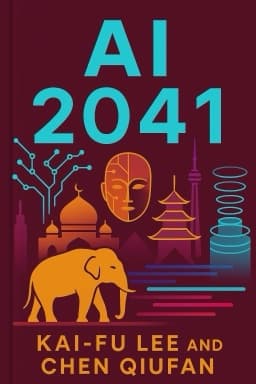
How AI 2041 Predicts the End of Jobs as We Know Them (and What Comes Next)
Explore the seismic shifts AI will bring to employment and how we can adapt to thrive in an automated world.

The rise of artificial intelligence promises to revolutionize the workplace, but what does that mean for millions of workers worldwide? In AI 2041, the authors explore the profound impact AI will have on employment, from automation of routine tasks to the emergence of new creative and empathetic roles. This blog unpacks these themes, offering insights on how to prepare for the future.
Automation and Job Displacement: The Inevitable Shift
AI excels at automating repetitive, predictable tasks found in manufacturing, clerical work, and certain service sectors. This leads to significant job displacement, causing economic and social disruption. However, jobs requiring creativity, emotional intelligence, and complex problem-solving remain more resilient. The key challenge is managing this transition without leaving workers behind.
Universal Basic Income: Safety Net or Social Experiment?
Universal Basic Income (UBI) is proposed as a solution to provide financial security amid job losses. While it offers unconditional support, critics worry about its effects on motivation and social cohesion. Successful implementation requires pairing UBI with retraining programs and community engagement to foster purpose and growth.
The 3Rs Framework: Relearn, Recalibrate, Renaissance
This framework guides adaptation to AI’s impact on work. 'Relearn' emphasizes acquiring new skills relevant to AI-enhanced roles. 'Recalibrate' involves adjusting work practices to collaborate effectively with AI. 'Renaissance' celebrates a creative revival where humans focus on uniquely human talents. Lifelong learning and policy support are essential to this transformation.
Human Courage in an Automated World
Stories within AI 2041 illustrate the human spirit’s resilience. For example, a young woman faces AI-driven social pressures but chooses to take risks worth having, guided by her mother’s wisdom. This reminds us that technology cannot replace human agency, courage, and connection.
Preparing for the future means investing in education, fostering adaptability, and building inclusive policies. AI will change work profoundly, but it also offers opportunities to redefine purpose and fulfillment.
Sources: Amazon, Goodreads, Global Policy Journal, Medium 1 2 3 4
Want to explore more insights from this book?
Read the full book summary