
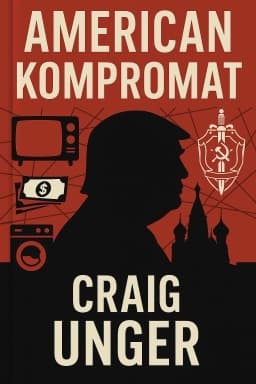
Is Donald Trump a Russian Asset? The Chilling Truth Behind Craig Unger’s Revelations
Unveiling decades of covert operations, money laundering, and espionage that shaped modern American politics.

In the shadowed corners of American political history lies a story so intricate and alarming that it challenges our understanding of democracy itself. Craig Unger’s House of Trump, House of Putin exposes a decades-long saga of espionage, money laundering, and covert influence that connects one of America's most controversial presidents with Russian intelligence and organized crime. This blog delves deep into the book’s core revelations, weaving together the strands of history, espionage, and political intrigue that define this chilling narrative.
From a Small Electronics Store to the Oval Office
Unger begins by spotlighting Joy-Lud Electronics, a seemingly innocuous New York store that specialized in Soviet-standard electronics. This store was more than a business; it was a KGB outpost where Soviet diplomats and spies acquired equipment free from American surveillance. Its co-owner, Semyon Kislin, was a spotter agent who identified potential assets—including a young Donald Trump, whose vanity and greed made him a prime candidate for cultivation. This early connection laid the groundwork for a complex relationship that would intertwine espionage with business and politics.
Money Laundering and the Russian Mafia’s Grip
The story deepens as Unger exposes how the Russian Mafia evolved in the 1980s from street-level crime to sophisticated financial operations. Trump Tower became a hub for laundering millions of dollars through all-cash condo purchases by individuals linked to Russian organized crime. Figures like David Bogatin and Tamir Sapir acted as conduits, blending illicit funds into Trump’s real estate empire, creating vulnerabilities ripe for exploitation by Russian intelligence.
Espionage and the Limits of Justice
Unger details the devastating impact of double agents like Aldrich Ames and Robert Hanssen, whose betrayals crippled US intelligence. He highlights how counterintelligence investigations, focused on national security rather than criminal prosecution, left many questions about foreign influence unanswered. This investigative gap allowed covert operations to persist under the radar, complicating efforts to hold perpetrators accountable.
The Hidden Power of Religious Networks
The book also explores the secretive influence of conservative Catholic organizations like Opus Dei, which protected spies and shaped the justice system. The case of an FBI mole who confessed espionage to an Opus Dei priest—who did not report him—illustrates the complex interplay between faith, secrecy, and national security. This religious cover added a layer of protection for espionage activities within US institutions.
Authoritarianism and Institutional Decay
Unger paints a vivid picture of the Trump presidency as a culmination of these covert influences. Characterized by over twenty thousand false claims, weaponization of federal agencies, and attacks on democratic norms, this era saw the erosion of trust and the rise of authoritarian tendencies. The politicization of oversight bodies and destabilization of electoral processes underscored the fragility of American democracy.
Disinformation and Active Measures
The KGB’s doctrine of active measures—disinformation, propaganda, and covert influence—played a critical role in shaping public opinion. Unger reveals how Trump’s 1987 newspaper ads echoed KGB talking points, showcasing a successful active measure operation. This strategic spread of falsehoods sowed division and confusion, undermining democratic discourse and enabling foreign influence.
The Epstein Scandal: Crime Meets Espionage
In a startling revelation, Unger connects the Jeffrey Epstein scandal to intelligence infiltration. Russian operatives infiltrated Epstein’s network, collecting kompromat on elites across politics and technology. Epstein’s ties to Israeli and Russian intelligence blur the lines between criminal enterprise and espionage, highlighting the multifaceted nature of modern covert operations.
The Road Ahead: Healing and Vigilance
Finally, Unger calls for renewed vigilance, transparency, and civic engagement to protect democracy. Education and media literacy are essential tools to combat disinformation and authoritarian threats. The resilience of democracy depends on informed citizens who demand accountability and uphold the rule of law.
Craig Unger’s work is a sobering reminder that democracy is fragile and must be actively defended. The revelations in House of Trump, House of Putin challenge us to confront uncomfortable truths and to recommit to the principles that sustain free societies.
References and further reading: Want to explore more insights from this book?