
From Print to Pixels: How Media Transformed Truth, Politics, and Religion
Tracing the Media-Driven Shift in Public Discourse and Cultural Values

Human societies have always been shaped by the dominant media through which they communicate. Neil Postman’s exploration of media evolution reveals that each medium carries its own epistemology—the way truth is defined and validated. In oral cultures, truth was communal and mnemonic, preserved through proverbs and spoken traditions. This form of knowledge emphasized memory and social cohesion.
With the advent of print culture, truth became fixed and objective, anchored in written documents. Literacy soared in colonial America, driven by religious and civic imperatives. Public discourse was rational, serious, and sustained by print’s linear logic. The Lyceum movement exemplified this, fostering adult education and intellectual debate.
The telegraph and photography introduced a new era of rapid, fragmented information. The 'peek-a-boo' world of news, characterized by sensationalism and novelty, diminished the relevance of context and coherence. Penny newspapers thrived on crime and scandal, reflecting a shift towards entertainment. This change set the stage for television’s dominance.
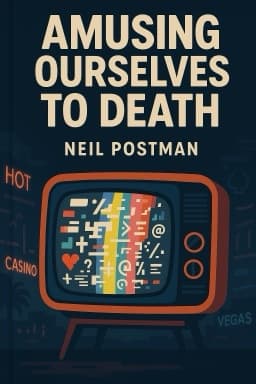
Television transformed all public discourse into show business. Politics became performance, with image and charisma overshadowing ideology. Religion turned into celebrity spectacle, prioritizing entertainment value over theological depth. The 'Now... This' news format exemplifies the fragmented, incoherent flow of information that undermines serious understanding. The consequences are profound, threatening democratic deliberation and spiritual authenticity.
To counter these trends, Postman advocates for media literacy—critical awareness of media’s influence—and educational reform to foster meaningful engagement. Understanding media’s role in shaping truth and culture is vital in the digital age, where new platforms continue to evolve these dynamics.
This blog integrates Postman’s insights with current perspectives, offering a comprehensive view of media’s transformative power and the challenges it poses to society.
Sources: Want to explore more insights from this book?