
Why Neil Postman’s ‘The Medium is the Metaphor’ Will Change How You See Media Forever
Unlocking the Hidden Power of Media to Shape Our Reality

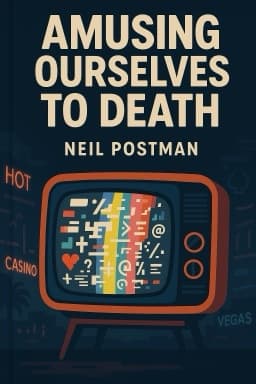
In an age saturated with information, understanding how the medium shapes our perception is more crucial than ever. Neil Postman, in his seminal work Amusing Ourselves to Death, argues that the medium through which we receive information is not just a passive channel but an active metaphor that molds the content and our understanding of it. This idea, a nuanced evolution of Marshall McLuhan’s famous dictum 'the medium is the message,' reveals that each communication medium brings its own worldview and biases, influencing how societies think, learn, and govern themselves.
The metaphor of Las Vegas, as Postman presents, symbolizes the transformation of American culture where politics, religion, and education have been subsumed into entertainment. This shift from serious public discourse to spectacle means that the medium—be it print, telegraph, or television—does not merely transmit information but defines the nature of that information itself.
Print culture fostered what Postman calls the 'typographic mind'—a rational, linear, and serious mode of thought that supported literacy, public debate, and democratic engagement. In contrast, the rise of electronic media, especially television, introduced a fragmented, image-driven world where entertainment dominates. The 'peek-a-boo' world of telegraph and the 'Now... This' style of TV news exemplify how information is presented in disjointed, context-free snippets, undermining coherence and depth.
Politics and religion, once domains of profound discourse, have become subsidiaries of show business. Political campaigns focus on image and charisma rather than ideology, and religious programming prioritizes spectacle over substance. This trivialization threatens the foundations of informed citizenship and cultural depth.
However, Postman’s work is not merely a lament but a call to awareness. By recognizing media as metaphor, we can cultivate media literacy and critical engagement, resisting the seduction of entertainment and reclaiming meaningful public discourse. This blog will guide you through these transformative ideas, drawing on multiple sources to provide a comprehensive understanding of how media shape our world and what we can do to navigate this complex landscape.
Understanding this framework is essential in an era dominated by digital media and social platforms, which continue to evolve the metaphors through which we perceive reality. Join us as we unpack Postman’s insights and their enduring relevance today.
Sources: Want to explore more insights from this book?