
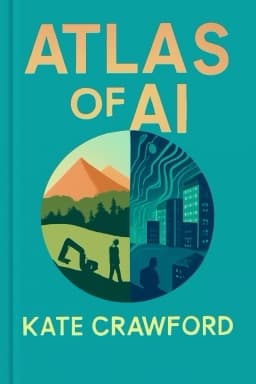
The Dark Truth Behind AI: What 'Atlas of AI' Reveals About Our Tech-Driven World
Unveiling the hidden costs and power structures behind artificial intelligence

Artificial Intelligence (AI) is often portrayed as the pinnacle of technological progress, a realm of ethereal algorithms and futuristic possibilities. However, Kate Crawford’s seminal work, Atlas of AI, shatters this illusion, revealing AI as a deeply material and political phenomenon. This book takes readers on an investigative journey that uncovers the hidden layers beneath AI’s polished surface — layers marked by environmental degradation, human labor exploitation, and entrenched power structures.
At the heart of AI’s infrastructure lie the earth’s finite resources. Lithium mining in Nevada’s Clayton Valley and toxic waste ponds in Inner Mongolia are stark reminders of the environmental costs that fuel our digital lives. These mining operations leave scars on landscapes and communities, producing waste that contaminates water and soil. AI’s physical foundations are thus inseparable from ecological harm.
Moving beyond materials, Crawford exposes the vast, often invisible human labor that powers AI. In Amazon warehouses, humans perform intricate picking and packing tasks alongside robots, enduring intense surveillance and physical strain. Globally, digital crowdworkers label data and moderate content for pennies, their toil hidden behind AI’s automated facade. This labor is essential yet undervalued, raising urgent questions about fairness and recognition.
Data itself is not neutral. The book highlights how datasets, such as mugshots used in facial recognition training, strip individuals of context and humanity, embedding systemic biases into AI systems. Classification systems, inherited from problematic scientific traditions, impose reductive categories of race and gender that reinforce social hierarchies and exclusion.
One of the most contentious areas Crawford discusses is affect recognition technology, which claims to read human emotions from facial expressions. Scientific evidence challenges the universality of such expressions, and the deployment of these technologies in hiring and policing contexts raises serious ethical concerns about privacy and misinterpretation.
Crucially, AI is not just a technological artifact but a tool of state power. Many AI systems originate from military research and are used extensively in surveillance and governance, blurring lines between civilian life and security apparatuses. This expansion amplifies state control and deepens societal inequalities.
At a structural level, AI reflects and magnifies existing power asymmetries. A handful of corporations dominate AI development, while labor and environmental costs are externalized. The knowledge AI produces shapes social norms and truths, often obscuring embedded biases and contestations.
Yet, Crawford’s work is not merely a critique; it is a call to action. Movements for data protection, labor rights, climate justice, and racial equity are converging to demand a just and sustainable AI future. The book ends on a hopeful note, emphasizing collective responsibility and interdisciplinary approaches to reshape AI in ways that respect human dignity and planetary health.
Why Read 'Atlas of AI'? This book is vital for anyone interested in understanding the full impact of AI beyond hype and headlines. It challenges technologists, policymakers, and the public to confront the uncomfortable realities of AI’s production and use, inspiring a more informed and ethical engagement with technology.
Whether you are a student, an activist, a professional in the tech industry, or simply a curious reader, 'Atlas of AI' offers a profound perspective on how AI is reshaping our world — and what it means for justice, equity, and the planet.
In sum, Kate Crawford’s 'Atlas of AI' dismantles the myth of AI as an autonomous, neutral force. Instead, it reveals AI as a complex web of material extraction, human labor, political power, and knowledge production — a web that demands our critical attention and collective action.
For a deeper dive into the ethical and political dimensions of AI, this book is an indispensable guide.
Sources: Technology Review, ScienceDirect, SCL, Critical Inquiry
Want to explore more insights from this book?
Read the full book summary