
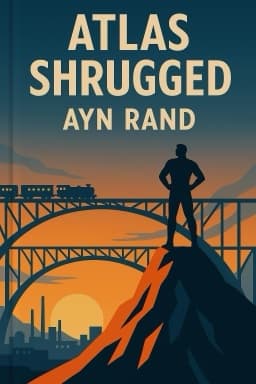
Unlocking the Mystery: Why ‘Atlas Shrugged’ Still Sparks Debate After Decades
Dive deep into the enduring relevance and controversy of Ayn Rand’s magnum opus.

Ayn Rand’s Atlas Shrugged is not just a novel; it’s a philosophical manifesto wrapped in a dramatic narrative that challenges readers to rethink the role of the individual in society. Since its publication in 1957, the book has inspired admiration and condemnation in equal measure. But what is it about this sprawling epic that keeps it relevant and controversial more than six decades later?
At its core, Atlas Shrugged champions the philosophy of Objectivism — a belief in reason, individualism, and laissez-faire capitalism. The story revolves around the mysterious disappearance of society’s most productive minds, led by the enigmatic John Galt, who withdraw their talents in protest against a world that punishes excellence and rewards mediocrity. This premise serves as a powerful allegory for the dangers of collectivism and government overreach.
The novel’s opening scenes set a somber tone, depicting a world in twilight, where decay creeps beneath the surface of once-mighty institutions. The metaphor of the broken oak tree and crumbling infrastructure illustrates the fragility of societal structures when reason is abandoned. The repeated question, “Who is John Galt?” becomes a haunting refrain, symbolizing a search for meaning amid confusion and despair.
Innovation and human achievement are celebrated through characters like Hank Rearden, whose creation of a revolutionary metal symbolizes hope and persistence. His decade-long struggle to perfect the alloy embodies the relentless human spirit striving against odds. Similarly, Dagny Taggart’s fight to keep her railroad running amidst bureaucratic decay highlights the importance of competence and vision as lifelines of progress.
However, the novel also starkly critiques collectivism. The rise of bureaucratic control and the suppression of individual rights lead to inefficiency and stagnation. The story warns of the hidden costs of policies that promise fairness but result in loss of freedom and productivity. The boardroom scenes, with their shadowy figures and chains of control, depict the suffocating grip of collectivist ideology.
John Galt’s strike — the withdrawal of the mind’s creative force — is the novel’s centerpiece. It dramatizes how society depends on the individual’s reason and effort, and how their absence can bring civilization to its knees. This quiet revolution is a moral and philosophical statement about the power and responsibility of the individual.
As the strike unfolds, the narrative explores the collapse of societal systems and the emotional toll on those left behind. Factories shut down, railroads halt, and despair spreads, exposing the fragile interdependence of modern life. Yet, from this darkness emerges a vision of renewal, symbolized by inventions like the motor — a beacon of human potential and harmony between progress and nature.
Ultimately, Atlas Shrugged is a celebration of reason, freedom, and moral responsibility. It challenges readers to embrace individual will and reject conformity, inspiring a vision of a world where innovation and liberty thrive together.
This enduring relevance and the passionate debates it inspires ensure that Atlas Shrugged remains a cornerstone of philosophical and literary discussion today.
Sources: CliffsNotes overview on Atlas Shrugged, The Atlas Society book reviews, PapersOwl critical analysis, WFLA literary study 1 2 3 4
Want to explore more insights from this book?
Read the full book summary