
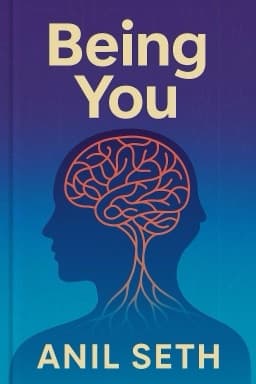
Is Your Reality Just a Controlled Hallucination? Inside Anil Seth’s Mind-Bending Science
Discover how your brain creates reality—and why nothing is quite as it seems.

Discover how your brain creates reality—and why nothing is quite as it seems.
Imagine opening your eyes in the morning. Instantly, the world appears—your room, the sunlight, the distant sound of birds. But what if this vivid reality is less a direct encounter with the world and more a creative construction of your brain? Neuroscientist Anil Seth’s 'Being You' offers a revolutionary answer: perception is a controlled hallucination. Every moment, your brain generates predictions about what’s out there, using sensory signals not as raw data but as feedback to correct its internal model. This isn’t just a metaphor: the same neural machinery that underpins ordinary perception also produces hallucinations when it becomes unmoored from reality.
Seth’s thesis draws on decades of neuroscience and philosophy. He shows how the brain’s predictions—shaped by memory, context, and expectation—are constantly tested against incoming sensory signals. When they match, you experience a seamless reality. When they clash, you see illusions or even hallucinations. This predictive processing doesn’t just apply to vision, but to every sense—including the hidden sense of interoception, which tracks the body’s internal state.
The implications are profound. Our sense of self—the feeling of being a unified, continuous 'me'—emerges from the brain’s predictions about the body. Experiments like the rubber hand illusion show how easily this sense can be tricked. And in altered states—dreams, psychedelics, meditation—the brain’s predictions become more flexible, revealing the plasticity of consciousness itself.
Seth’s work also raises ethical and philosophical questions. If consciousness is a matter of prediction and integration, could animals or even machines be conscious? What does this mean for how we treat other minds?
In the end, 'Being You' is an invitation to humility and wonder. It reminds us that reality is not simply 'out there,' but is actively constructed within us. To understand consciousness is to appreciate the fragile, creative, and deeply personal nature of experience.
So next time you open your eyes, remember: what you see is not the world itself, but your brain’s best guess—a beautiful, ever-changing hallucination, grounded by the gentle tug of the senses.
References: Being You by Anil Seth, LSE Review
1
, Mountains & Rivers Review
2
, Anil Seth’s official site
3
Want to explore more insights from this book?
Read the full book summary