
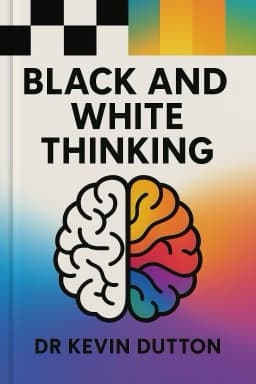
Why Your Brain Loves Black and White Thinking — And How It's Holding You Back
Unpacking the evolutionary roots of binary thinking and how embracing nuance can transform your life.

Have you ever caught yourself thinking in absolutes? Maybe you’ve labeled a situation as entirely good or bad, or judged someone as friend or foe without room for nuance. This tendency to see the world in black and white is not just a quirk of personality; it's a fundamental feature of how our brains operate.
From infancy, humans exhibit an astonishing ability to sort sensory input into categories. Even four-month-old babies distinguish between cats and dogs, demonstrating that categorization is innate, not learned. This ability evolved because quick identification of threats and resources was vital for our ancestors. Spotting a predator or a safe fruit could mean life or death. Thus, our brains developed a binary filtering system: friend or foe, edible or poisonous, safe or dangerous.
However, this binary lens often oversimplifies reality. The Sorites paradox, for instance, illustrates the fuzziness of categories — how many grains of sand make a heap? There is no precise boundary, yet we crave definitive lines. Our senses also limit us; Weber's Law tells us that changes are only noticed beyond a threshold, forcing the brain to lump continuous phenomena into discrete groups.
These cognitive shortcuts have social consequences. Binary thinking fuels in-group loyalty but also out-group hostility, laying the groundwork for prejudice, stereotyping, and conflict. Whether in politics, religion, or everyday social interactions, rigid categories can be weaponized to exclude and demonize. This tribalism is exacerbated by language and framing — the words we use shape how we perceive categories and influence decisions. A subtle change in wording can turn a 'secret' into a 'surprise,' dramatically altering behavior.
Moreover, our cognitive limits constrain how many options or categories we can handle. The famous 'seven plus or minus two' rule highlights that we can juggle only about seven chunks of information at once. When faced with too many choices, we experience choice overload, leading to indecision and dissatisfaction. This tyranny of choice is evident in everyday scenarios like shopping or decision-making at work.
So, how do we overcome these limitations? The key lies in cognitive flexibility — the mental ability to shift perspectives and embrace ambiguity. This flexibility reduces anxiety, improves problem-solving, and fosters empathy. Like a skilled chess player who zooms in and out between details and the big picture, we must learn to adjust our focus dynamically.
Ultimately, wisdom comes from transcending black and white thinking to embrace the rich spectrum of grey. This nuanced view fosters social harmony by reducing conflict and building bridges across divides. By understanding the evolutionary roots and cognitive mechanics behind our binary thinking, and by cultivating flexibility and mindfulness, we can navigate life's complexities with greater grace and insight.
Whether you're seeking better mental health, improved decision-making, or more empathetic relationships, recognizing and moving beyond black and white thinking is a transformative step.
Sources: sobrief.com on black and white thinking 1 , amazon.com overview of the book 2 , bookey.app summary 3
Want to explore more insights from this book?
Read the full book summary