
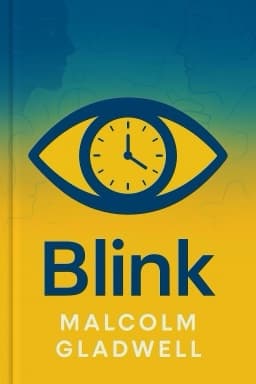
Unlocking Your Brain’s Secret Superpower: How ‘Blink’ Reveals the Magic of Instant Decisions
Discover the astonishing science behind the snap judgments that shape your life every day.

Imagine standing in a crowded room, meeting someone for the first time. Within seconds, your mind has already formed an impression — a feeling about their trustworthiness, competence, or likability. This rapid judgment, often called a 'blink' decision, happens so fast that we rarely notice it. Yet, as Malcolm Gladwell reveals in his groundbreaking book Blink, these split-second assessments can be as accurate as decisions made after hours of thought.
Gladwell introduces the concept of 'thin-slicing' — the ability to extract meaningful information from very limited data. For example, psychologists can predict with over 90% accuracy whether couples will stay together by watching just a few minutes of their interactions. Similarly, strangers can assess personality traits by briefly observing a person’s living space. These findings challenge the belief that more information and conscious analysis always lead to better decisions.
But how does this unconscious process work? Gladwell describes the 'locked door' of the unconscious mind where rapid cognition takes place. This hidden realm processes subtle cues like microexpressions, tone of voice, and physiological signals that our conscious mind can’t fully access. For instance, a tennis coach could predict double faults long before consciously realizing why, relying on unconscious pattern detection. Yet, this power is a double-edged sword — biases and stereotypes can distort snap judgments, leading to errors like the 'Warren Harding error,' where people mistake a person's appearance for competence.
Gladwell also emphasizes the role of structure and training in enhancing intuition. A military commander’s victory in a war game against a technologically superior force showed how experience and flexible thinking can outperform data-heavy analysis. Just like improvisational theater thrives within rules, rapid cognition requires a framework to be effective. Overthinking can actually impair intuition, a phenomenon known as verbal overshadowing, which explains why experts sometimes perform worse when asked to explain their quick decisions.
Moreover, the book explores the complex relationship between what people say they want and what they actually prefer. The story of musician Kenna highlights how conscious preferences can conflict with unconscious attractions, challenging marketers and artists to rethink how they understand consumer behavior.
Reading microexpressions — fleeting facial expressions that last less than a second — is another fascinating aspect of rapid cognition. These universal expressions reveal true emotions hidden beneath words and can be crucial in law enforcement and interpersonal communication.
Ultimately, 'Blink' teaches us to cultivate our rapid cognition through experience and mindful awareness, balancing instinct with reflection. By understanding the power and limits of snap judgments, we can navigate life’s complexities with greater confidence and empathy.
Ready to unlock your brain’s secret superpower? Dive into the world of rapid cognition and discover how your mind’s blink decisions shape your reality every day.
Want to explore more insights from this book?
Read the full book summary