
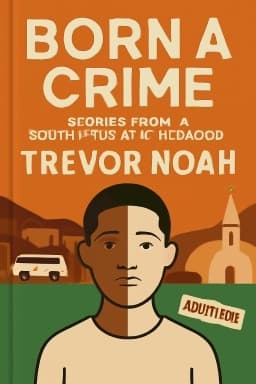
Born a Crime: The Untold Story of Growing Up Illegal in Apartheid South Africa
How a Mixed-Race Child Survived and Thrived Under the Harshest Laws

Imagine being born into a world where your very existence is a crime. This is the paradox at the heart of Trevor Noah's memoir, Born a Crime. Born to a black South African mother and a white Swiss father during apartheid, Noah’s life began under the shadow of laws that criminalized interracial relationships. The apartheid government’s obsession with racial purity meant that children like him were invisible, illegal, and forced to navigate a society built on segregation and suspicion.
The Absurdity of Apartheid’s Racial Laws
One of the most striking revelations in Noah’s story is the arbitrary and often surreal methods used to enforce racial categories. The infamous 'pencil test,' where a pencil placed in a person’s hair would determine their race based on whether it fell out or stayed, epitomizes the illogical nature of apartheid. These classifications dictated every aspect of life—from where one could live, whom one could marry, to what education and jobs were accessible. Noah’s existence defied these rules, forcing his family to hide their relationship and their child to live in a constant state of fear and secrecy.
Faith and Community as Pillars of Strength
Amidst this oppression, faith emerged as a vital source of hope and resilience. Noah’s mother, a devout Christian, led prayer meetings that became community lifelines, especially for women who held families together in the absence of men. These gatherings were not just spiritual but social anchors, offering strength in a turbulent world. The blending of Christianity with indigenous beliefs also reflected the complex cultural tapestry of South Africa, where traditional healing and ancestral worship coexisted with church rituals.
The Power of Language and Identity
Language played a crucial role in Noah’s survival and identity formation. In apartheid South Africa, language was a tool of division, with schools teaching children only in their home languages to reinforce tribal and racial barriers. Yet Noah mastered multiple languages, using them as bridges to connect with diverse groups and defuse tensions. English, in particular, was a gateway to opportunity, symbolizing education and social mobility. This linguistic dexterity became a form of rebellion and empowerment, allowing Noah to navigate complex social landscapes.
Family as a Fortress
The memoir highlights the pivotal role of women in maintaining family and community cohesion. With many men absent due to work or imprisonment, women like Noah’s mother became the matriarchs and spiritual leaders. Their tough love, discipline, and unwavering support created a foundation of resilience. The phrase 'When you strike a woman, you strike a rock' encapsulates their strength and centrality to survival in a fractured society.
Childhood Mischief and Discipline
Noah’s boundless energy and curiosity often led to mischief, balanced by his mother’s strict discipline. This dynamic shaped his character, teaching him boundaries while fueling his creativity and adaptability. His childhood was a microcosm of the larger societal chaos—full of danger, humor, and lessons in survival.
Navigating Violence and Danger
Violence was a constant threat, from gang conflicts in minibus taxis to political unrest and brutal punishments like necklacing. Survival demanded quick instincts and protective maternal actions. These experiences forged a deep awareness of the dangers lurking in everyday life and the resilience required to face them.
Education as Liberation
Despite systemic efforts to limit black South Africans’ education through the Bantu system, Noah’s pursuit of knowledge became a path to freedom. Mastering English and excelling in school opened doors otherwise closed by apartheid’s oppressive structures. Education was not just academic but a form of resistance and hope.
Humor and Identity: From Shadows to Spotlight
Ultimately, Noah’s story is one of transformation. Humor became his weapon against adversity, a way to process pain and connect with others. Embracing his complex identity allowed him to reclaim his narrative and build a future beyond apartheid’s shadows. His journey from a 'crime' to a celebrated voice is a powerful testament to human resilience and the transformative power of laughter.
Trevor Noah’s Born a Crime offers profound insights into a dark chapter of history while inspiring hope for overcoming division through love, faith, education, and humor. It invites readers to reflect on identity, injustice, and the enduring strength of the human spirit.
Sources: SparkNotes Analysis, Christina Allday Review, Medium Deep Dive 1 2 4
Want to explore more insights from this book?
Read the full book summary