
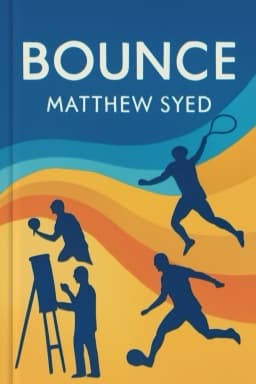
Why Talent Is Overrated: The Real Secret Behind Extraordinary Success
Unveiling the Myths of Natural Talent and Discovering the Power of Relentless Practice

For generations, we’ve been told that world-class athletes, musicians, and entrepreneurs are simply born different. The myth of talent is seductive: it gives us neat explanations for why Roger Federer swings a racket like no one else, or why Mozart composed symphonies as a child. But what if this story is not just incomplete, but fundamentally wrong? In 'Bounce,' Matthew Syed explodes the myth of natural talent, arguing that the true engine of excellence is not a genetic lottery but a relentless, purposeful practice combined with the right opportunities and support.
Syed’s journey starts on Silverdale Road, a nondescript street in Reading, England, which improbably produced more top table tennis players than anywhere else in the UK. Was it genetics? No—these champions were forged by a unique combination of access to equipment, passionate local coaches, and a culture that celebrated the sport. Their hours in the garage, competing with siblings and friends, created a hidden advantage that outsiders mistook for innate brilliance.
Syed introduces us to the science behind the '10,000-hour rule,' a concept popularized by psychologist Anders Ericsson. Studies of elite violinists, chess grandmasters, and athletes reveal a common thread: mastery is built over years of focused, challenging practice. Even prodigies are not exceptions—they simply start earlier, compressing years of effort into childhood. This is not to say talent doesn’t exist, but that its role is vastly overstated compared to the transformative power of deliberate practice.
But not all practice is created equal. Syed distinguishes between mindless repetition and 'purposeful practice'—the kind that targets weaknesses, seeks constant feedback, and pushes us beyond our comfort zones. It is this feedback loop, not just the hours, that rewires our brains and bodies for peak performance. The best in any field are those who embrace failure as a teacher, using every stumble as a stepping stone to greater skill.
One of the most compelling ideas in 'Bounce' is the concept of 'autobiographical bias.' Successful people often credit their own grit and perseverance, forgetting the support, luck, and opportunities that paved their way. This bias fuels the myth of meritocracy and blinds us to the hidden scaffolding beneath every achievement. For readers, this realization is liberating: greatness is not reserved for the chosen few, but is accessible to all who are willing to put in the work and seek out the right environment.
So, what does this mean for you? Whether you’re striving to master an instrument, launch a business, or simply improve at your favorite hobby, the lessons of 'Bounce' are clear: seek feedback, embrace purposeful practice, and remember that your journey is shaped as much by your environment as your effort. The next time you marvel at a champion, remember the garage, the coach, and the thousands of unseen hours behind every moment of glory.
For a deeper dive, check out the full book summary and expert reviews for more actionable insights. 2 3
Want to explore more insights from this book?
Read the full book summary