
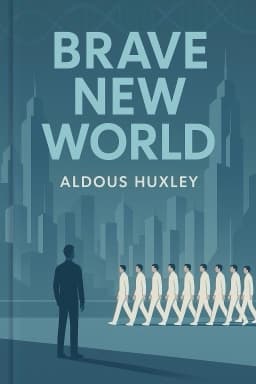
10 Shocking Ways ‘Brave New World’ Predicted Our Future
How Huxley’s Vision Became Our Reality

When Aldous Huxley published ‘Brave New World’ in 1932, few could have imagined how eerily accurate his vision of the future would become. The novel’s World State is a society obsessed with comfort, efficiency, and control, where individuality is sacrificed for the collective good. Today, as we grapple with technological advances, bioengineering, and the omnipresence of digital entertainment, Huxley’s warnings feel more relevant than ever.
1. Genetic Engineering and Designer Babies
Huxley’s depiction of babies grown in bottles and assigned to castes through genetic manipulation was pure science fiction in his day. Now, with CRISPR and gene editing, the idea of ‘designer babies’ is no longer far-fetched. Scientists can already screen embryos for certain traits, raising ethical questions about the limits of human intervention.
2. Mood-Altering Drugs
The citizens of the World State rely on ‘soma’ to erase negative emotions. In our world, the rise of antidepressants, anti-anxiety medications, and recreational drug use reflects a similar desire to escape discomfort. The opioid crisis shows the dark side of this pursuit of chemical happiness.
3. Mass Entertainment and Distraction
In Huxley’s world, people are bombarded with endless distractions—feelies, games, and shallow entertainment. Today, smartphones, streaming platforms, and social media keep us constantly entertained, often at the expense of deep thought and real connection.
4. Surveillance and Loss of Privacy
While Huxley’s state maintains order through conditioning rather than brute force, the omnipresence of surveillance is a chilling parallel to today’s world of CCTV, data tracking, and social credit systems.
5. The Commodification of Happiness
Huxley’s society has turned happiness into a product, distributed by the state. Similarly, modern marketing promises happiness through consumption, and governments increasingly measure success in terms of ‘well-being’ indices.
6. The Decline of Family and Religion
In the World State, traditional families are obsolete, and religion is replaced by rituals celebrating technology. The decline of religious observance and the transformation of family structures in many societies echo this shift.
7. The Dangers of Conformity
Huxley warned of the loss of individuality in a society obsessed with sameness. Today’s social media algorithms and cancel culture can enforce conformity and suppress dissent.
8. The Power of Conditioning
From cradle to grave, World State citizens are conditioned to accept their roles. Modern advertising, education, and media shape our desires and beliefs in subtle but powerful ways.
9. The Erosion of Free Will
Perhaps the most disturbing prediction is the erosion of free will. In a world where every desire is anticipated and fulfilled, the capacity for independent thought and action withers.
10. The Price of Stability
Huxley’s ultimate question remains: Is it worth sacrificing freedom, art, and love for the sake of comfort and stability? As technology advances, this dilemma becomes increasingly urgent.
‘Brave New World’ is not just a warning—it’s a mirror. As we look into it, we must ask ourselves what kind of future we want to create.
References: SparkNotes, Britannica, Medium, The Artifice
Want to explore more insights from this book?
Read the full book summary