
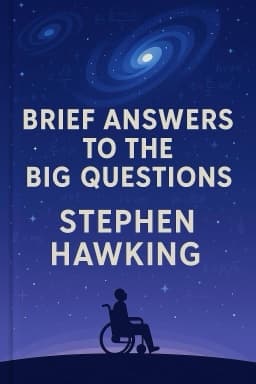
10 Mind-Bending Answers from Stephen Hawking That Will Change How You See the Universe
Explore the universe’s greatest mysteries through the eyes of a genius.

1. The Power of Asking Questions
Stephen Hawking’s life was a testament to the power of curiosity. Diagnosed with ALS at 21, he was given just a few years to live, yet he transformed adversity into a relentless pursuit of the universe’s secrets. Hawking believed that everyone—no matter their background or education—could grasp the wonders of the cosmos if only the ideas were explained clearly. He dedicated his life to making science accessible, writing bestsellers and giving lectures that inspired millions. His story is a reminder that adversity can spark innovation, and that the most profound discoveries often begin with a simple question: Why?
2. Is There a God?
One of the book’s boldest chapters tackles the question of God’s existence. Hawking argues that the universe is governed by unbreakable laws—laws that do not require a divine hand to set them in motion. He draws on Einstein’s metaphor of ‘knowing the mind of God,’ explaining that for him, understanding the laws of nature is the ultimate goal. Hawking’s explanation of the Big Bang, where time and space themselves begin, leaves no room for a ‘before’ or for a creator outside the system. Yet, he acknowledges the poetic power of calling the laws of physics ‘God’—a metaphor, not a deity. This nuanced view bridges science and philosophy, inviting readers to find wonder in the universe’s order and beauty. 1
3. The Universe’s Grand Beginning
Hawking guides us through the birth and evolution of the universe, from the first moments of the Big Bang to the formation of stars and galaxies. He explains how the cosmic microwave background—a faint afterglow of creation—provides evidence of our universe’s hot, dense origins. The blog explores the anthropic principle, which suggests that the universe is suited for life because we are here to observe it. Quantum mechanics and the ‘no-boundary proposal’ add layers of complexity, showing that the universe may have many possible histories. Hawking’s narrative connects ancient creation myths to cutting-edge science, revealing how our understanding has evolved. 2
4. Are We Alone?
The search for extraterrestrial life is one of humanity’s oldest dreams. Hawking highlights the rapid emergence of life on Earth and the discovery of thousands of exoplanets as reasons to believe life may be common in the universe. Yet, the silence of the cosmos—the Fermi Paradox—suggests that intelligent life may be rare, or that civilizations are separated by vast distances. Hawking warns that if we do encounter advanced aliens, their intentions may not be benign, drawing on sobering historical analogies. The ongoing search for radio signals and microbial life on Mars keeps hope alive, turning the question of cosmic company from fantasy to scientific pursuit. 3
5. Black Holes: Monsters and Gateways
Perhaps Hawking’s greatest legacy lies in his work on black holes. Once thought to be cosmic monsters, black holes are revealed as laboratories for new physics. Hawking’s discovery that black holes emit radiation—now called Hawking radiation—transformed our understanding. This revelation led to the information paradox, a puzzle that challenges the foundations of quantum mechanics. The blog explains how black holes can evaporate over time and why they are defined only by mass, charge, and spin. These insights connect the smallest quantum mysteries to the largest cosmic phenomena, showing that black holes are not just destroyers, but also creators of knowledge. 4
6. The Limits of Prediction
Can we predict the future? Hawking answers with a resounding ‘no’—at least, not perfectly. Chaos theory and quantum uncertainty mean that even with all the laws of physics, the universe is fundamentally unpredictable. The butterfly effect shows how small changes can have huge consequences, while the uncertainty principle limits what we can know about the tiniest particles. Black holes add another layer of unpredictability, scrambling information in ways that challenge our deepest theories. Yet, this uncertainty is a source of beauty and freedom, allowing for creativity and free will in a universe of possibility.
7. Humanity’s Future: Hope Among the Stars
Hawking ends with a call to action. He warns of existential risks—climate change, nuclear war, and the dangers of unchecked AI—but remains optimistic about humanity’s ability to overcome them. He advocates for global cooperation, investment in science, and a shared vision for a better future. Most importantly, he urges us to look beyond Earth, to dream of life among the stars. Colonizing other planets is not just a fantasy, but a necessity for survival. Hawking’s legacy is a message of hope: that curiosity, courage, and unity can carry us to the stars and beyond.
Conclusion
Stephen Hawking’s 'Brief Answers to the Big Questions' is more than a collection of scientific essays. It is a love letter to curiosity, a celebration of the human spirit, and a roadmap for the future. By making the universe’s deepest mysteries accessible, Hawking invites us all to join the adventure of discovery. Whether you are a scientist, a dreamer, or simply someone who looks up at the night sky in wonder, this book—and this blog—will change how you see yourself and your place in the cosmos.
Want to explore more insights from this book?
Read the full book summary