
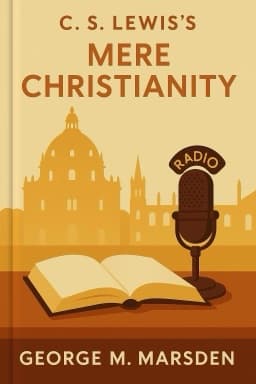
Unlocking the Secrets of Mere Christianity: The Timeless Guide That Changed Faith Forever
Discover how C.S. Lewis’s wartime radio talks became the foundational blueprint for modern Christian thought.

From Wartime Broadcasts to a Spiritual Lifeline
Imagine Britain under siege during World War II, cities battered by relentless bombings, and a nation grappling with fear and uncertainty. Amid this turmoil, a scholar and former soldier took to the airwaves, offering not just comfort but a reasoned and hopeful vision of faith. These broadcasts became the foundation of what we now know as Mere Christianity. Lewis’s unique voice combined intellectual clarity with a gentle, optimistic tone, addressing millions who sought meaning beyond the chaos.
The Universal Moral Law: A Shared Human Experience
Lewis begins by observing that all humans, regardless of culture or background, recognize a common moral law. This law is not a mere social convention but an objective standard governing right and wrong. Everyday quarrels—over seats, promises, or fairness—reveal this innate sense. Using the analogy of a cinema operator controlling the film but not being part of the screen, Lewis points to a transcendent Lawgiver beyond the universe.
This insight challenges modern skepticism, inviting readers to reconsider the foundations of morality and reason. If our thoughts are mere by-products of atoms, how can we trust them? This paradox forces a deeper reflection on faith and intellect.
The Shocking Alternative: Jesus as Liar, Lunatic, or Lord
One of the most famous parts of the book is the trilemma: Jesus must be a liar, a lunatic, or the Lord. Lewis dismantles the idea that Jesus was just a great moral teacher by highlighting the radical nature of his claims—divine authority, forgiveness of sins, and promises of eternal life. This argument demands a decisive choice, rejecting comfortable neutrality.
Walking along a moonlit riverside path, Lewis’s metaphorical figures represent the listener’s own struggle with this profound question. The clarity of this challenge has sparked both admiration and controversy, forcing readers to confront the implications of faith.
Living the Faith: The Practical Demands of Christian Morality
Faith is not just belief but transformation. Lewis outlines three parts of morality: fair play among individuals, inner harmony within oneself, and the pursuit of life’s ultimate purpose. Virtues like prudence, justice, faith, hope, and charity are not abstract ideals but skills to be practiced, like a tennis player mastering the game.
Sexual morality, a challenging topic, is addressed with honesty and grace, emphasizing chastity and renewed dependence on divine help. This practical guidance invites believers to become 'little Christs,' embodying love and integrity in everyday life.
Polarized Reception: Loved and Hated
Lewis’s bold apologetics provoked strong reactions. While some British intellectuals and atheist publications harshly criticized the work, American evangelical circles embraced it enthusiastically. This cultural divide shaped the book’s legacy, with figures like Billy Graham popularizing it in the U.S. and institutions like Wheaton College preserving its influence.
The passionate responses reveal the enduring power of Lewis’s message, which continues to inspire debate and devotion.
Ecumenical Bridge and Evangelical Cornerstone
By focusing on 'mere Christianity,' Lewis crafted a message that transcended denominational divides, appealing to Catholics, Orthodox, and Protestants alike. This practical ecumenism fostered unity and dialogue, making the book a staple in evangelical education and apologetics.
The endorsement of prominent evangelists and the scholarly work of institutions like Wheaton College helped cement its place in Christian thought worldwide.
Why Mere Christianity Still Speaks to Our Souls
Mere Christianity’s timelessness lies in its blend of reason and imagination, its global reach, and its humility in acknowledging limitations. Translated into over 30 languages, it resonates across cultures. Its style engages both intellect and heart, inviting readers into an ongoing conversation. Lewis’s metaphor of a hall with many doors symbolizes the respectful openness that continues to draw readers into Christian faith.
Conclusion
From wartime broadcasts to a global spiritual classic, Mere Christianity remains a beacon of hope, reason, and love. Its insights challenge us to face profound questions with courage and kindness, inviting us to live transformed lives grounded in a shared moral law and the radical claims of Jesus Christ.
Whether you are a seeker, a skeptic, or a believer, this timeless work offers a path illuminated by clarity and compassion.
Want to explore more insights from this book?
Read the full book summary