
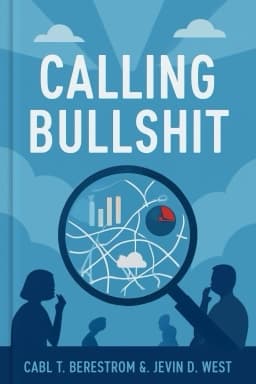
How to Spot Bullshit in the Age of Information Overload: 7 Life-Changing Lessons from 'Calling Bullshit'
Transform Your Skepticism into a Superpower with These Actionable Insights

Transform Your Skepticism into a Superpower with These Actionable Insights
Information is everywhere—on your phone, your TV, your social feed. But with great information comes great responsibility: the need to separate fact from fiction, insight from illusion. 'Calling Bullshit: The Art of Skepticism in a Data-Driven World' is the ultimate guide for anyone who wants to thrive in this environment.
Lesson 1: Recognize Bullshit Before It Spreads
One of the book’s most powerful messages is that bullshit is not always malicious—sometimes it’s just careless, lazy, or the result of wishful thinking. The first step to being a skeptic is to slow down and ask, 'Does this make sense?' For example, viral claims about miracle cures or shocking statistics often fall apart under scrutiny. Tip: If a headline sounds too good (or too bad) to be true, it probably is.
Lesson 2: Numbers Can Lie (If You Let Them)
Numbers are persuasive, but they can be twisted to fit almost any narrative. The book explores how misleading graphs, cherry-picked statistics, and 'mathiness' (pseudo-mathematical jargon) can create the illusion of truth. For instance, a chart might exaggerate trends by manipulating the y-axis, or a study might use a tiny, unrepresentative sample. Tip: Always check the source of data and ask what’s missing.
Lesson 3: Correlation Does Not Equal Causation
Just because two things happen together doesn’t mean one caused the other. The book gives hilarious (and sometimes alarming) examples, like ice cream sales rising with shark attacks—not because one causes the other, but because both increase in summer. Tip: Look for hidden variables and ask if there’s real evidence of cause and effect.
Lesson 4: Beware of Selection Bias
Who’s included—and who’s left out—can change the story entirely. The authors explain how sampling errors and selection bias can make research results meaningless. For example, if a survey about happiness only asks people at a music festival, the results will be skewed. Tip: Ask how the sample was chosen and if it represents the whole group.
Lesson 5: Algorithms Aren’t Neutral
Algorithms decide what you see online, but they are not impartial. They amplify what grabs your attention, not what’s true. The book warns about filter bubbles and echo chambers, where you only see information that matches your beliefs. Tip: Seek out diverse perspectives and question why you’re seeing certain content.
Lesson 6: Ask the Right Questions
The best defense against bullshit is curiosity. The authors provide a checklist of questions: Who benefits? What’s the evidence? Can I verify this elsewhere? These simple queries can reveal hidden motives and shaky foundations. Tip: Make questioning a habit, not a chore.
Lesson 7: Build a Community of Skeptics
Critical thinking is contagious. When you model skepticism, others follow. The book highlights media literacy movements and the power of communities to resist misinformation. Tip: Share your knowledge, discuss claims openly, and support fact-checking efforts.
In conclusion, 'Calling Bullshit' is more than a book—it’s a movement. By embracing skepticism, asking better questions, and supporting one another, we can all become defenders of truth in a noisy world.
Want to explore more insights from this book?
Read the full book summary