
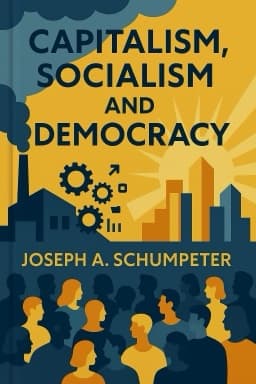
Why Schumpeter Still Matters: Lessons from Capitalism, Socialism, and Democracy in the Age of AI
How Schumpeter’s Vision Explains Today’s Economic Upheavals

Introduction: Joseph Schumpeter’s classic work, Capitalism, Socialism, and Democracy, is more than an economic treatise—it’s a map for navigating the stormy seas of modern change. In the book, Schumpeter describes capitalism as a living, breathing organism, constantly evolving through a process he famously called ‘creative destruction.’ This concept is especially relevant today, as artificial intelligence and automation disrupt old ways of working and living. But what did Schumpeter really mean by creative destruction, and how does it apply to our current moment?
Schumpeter argued that capitalism’s greatest strength—its ability to innovate and create new industries—was also its greatest weakness. The very process that brings about progress also destroys jobs, communities, and even entire ways of life. In today’s world, we see echoes of this everywhere: traditional retail chains shuttered by e-commerce, taxi drivers displaced by ride-sharing apps, and whole professions threatened by AI-powered automation. The winners of this process are often handsomely rewarded, while the losers face uncertainty and insecurity.
Yet, Schumpeter was not simply a prophet of doom. He believed that societies could adapt, that new opportunities would arise from the ashes of the old. The challenge, he warned, was that the very prosperity created by capitalism could undermine its foundations. As people grow comfortable, they may take for granted the institutions and values that made their wealth possible. Intellectuals and critics—what Schumpeter called the ‘class of intellectuals’—can turn public opinion against capitalism, especially when inequality rises and social trust erodes. This is not just a theoretical danger; it’s a reality we witness today in the growing polarization and skepticism toward established institutions.
Schumpeter’s analysis of socialism was equally nuanced. He did not dismiss the possibility that socialism could work; rather, he questioned whether it could match capitalism’s dynamism and capacity for innovation. Central planning, he argued, faces the ‘calculation problem’: without the price signals generated by market competition, planners struggle to allocate resources efficiently. Even more challenging is the problem of motivation—how to inspire individuals to excel and innovate when rewards are less directly tied to effort and risk-taking.
The rise of AI and big data has led some to revisit the dream of rational, centrally planned economies. Could technology solve the calculation problem? While algorithms can process vast amounts of data, the unpredictability of human behavior and the need for personal incentives remain stubborn obstacles. The lesson from Schumpeter is clear: economic systems are not just about numbers—they are about people, with all their hopes, fears, and creativity.
As we look to the future, Schumpeter’s warning about the fragility of success is particularly poignant. The very achievements of capitalism—its wealth, comfort, and innovation—can breed complacency and discontent. If societies fail to adapt, if they neglect the values and institutions that sustain progress, they risk decline.
Ultimately, Schumpeter’s message is one of cautious optimism. Change is inevitable, but it is also an opportunity. By embracing innovation while remembering the human costs, by balancing competition with compassion, societies can navigate the turbulent waters of creative destruction and build a future that honors both progress and people.
Conclusion: Schumpeter’s vision remains a beacon for our times. In an age of AI, automation, and global upheaval, his insights into the dynamics of capitalism, the challenges of socialism, and the importance of democracy are more relevant than ever. The future is unwritten—but with Schumpeter’s wisdom, we can write it well.
Want to explore more insights from this book?
Read the full book summary