
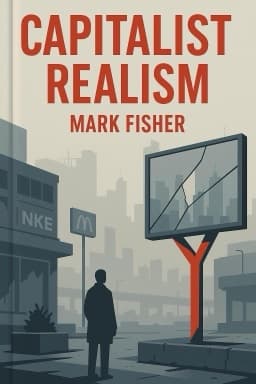
Is Capitalism Truly Unstoppable? Inside the Mind-Bending World of Capitalist Realism
How Mark Fisher’s Capitalist Realism Unveils the Illusion of an Inevitable Economic Order

What if the future itself seemed to vanish, leaving only a dull, gray present where capitalism reigns supreme and no alternative seems possible? This is the haunting premise of Mark Fisher's Capitalist Realism, a concept that captures the invisible yet crushing grip capitalism holds over our imagination and culture. Fisher argues that capitalist realism is more than an economic system; it is a cultural and ideological atmosphere that convinces us capitalism is the natural order of things—unchallengeable and eternal.
At the heart of capitalist realism lies a paradox: while capitalism promises freedom, flexibility, and innovation, it simultaneously breeds political disengagement, mental health crises, and cultural stagnation. Young people, aware of systemic problems yet feeling powerless to change them, embody what Fisher calls 'reflexive impotence.' Education systems, once sites of empowerment, have become market-driven spaces filled with boredom and distraction, reflecting the neoliberal emphasis on performance metrics over genuine learning.
The shift from Fordism to post-Fordism exemplifies this transformation. Gone are the days of stable, lifelong employment. Instead, workers navigate precarious, flexible jobs demanding constant re-skilling, blurring the boundaries between work and life, and exacerbating stress and mental illness. Bureaucracy, far from disappearing, has mutated into 'market Stalinism,' a regime of intensified surveillance and self-monitoring that drains creativity and autonomy.
Capitalist realism also functions like a collective dreamwork, weaving a seamless narrative that suppresses contradictions and fractures memory. Films and cultural products depicting amnesia and identity loss metaphorically reflect this disjointed social reality. Yet, within this oppressive dream lies the possibility of awakening. Recognizing capitalism’s contingency and inventing new political languages are essential steps toward resistance.
Fisher’s work challenges us to break free from the ideological prison of capitalist realism, to imagine futures beyond the 'end of alternatives.' It is a call to reclaim hope, agency, and collective action in an era dominated by neoliberal logic.
For those seeking a profound critique of contemporary capitalism and a pathway toward political renewal, understanding capitalist realism is indispensable.
Sources and further reading include analyses from brieflane.com, nosiarch.wordpress.com, and Wikipedia, which provide comprehensive summaries and discussions of Fisher’s ideas. 1 2 3
Want to explore more insights from this book?
Read the full book summary