
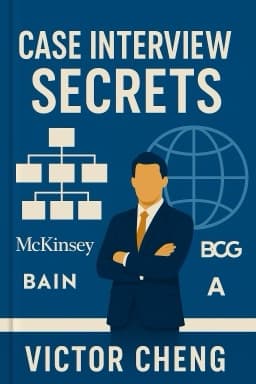
Unlocking Consulting Secrets: How to Ace Case Interviews Like a Pro
Discover the insider strategies from a former McKinsey consultant to master case interviews and land your dream consulting job.

Case interviews are the gateway to the coveted world of management consulting. But what makes them so challenging? At their core, they are simulations of real consulting problems where your ability to think clearly, structure problems, and communicate effectively is tested under pressure.
One of the foundational insights from Victor Cheng's 'Case Interview Secrets' is the power of the hypothesis-driven approach. Instead of blindly analyzing every detail, you start with an educated guess about the root cause of the problem. This hypothesis acts as a compass, guiding your analysis efficiently. For example, if a company's profits are declining, hypothesizing that rising costs rather than falling sales are responsible focuses your investigation.
To organize your thinking, you use issue trees—logical diagrams that break down problems into mutually exclusive and collectively exhaustive parts. This ensures no stone is left unturned and prevents overlap in analysis. Imagine profitability being split into revenue and cost branches, each further dissected into price, volume, fixed costs, and variable costs. This clarity is essential for thoroughness.
Frameworks are another vital tool, but Cheng warns against rigid memorization. Frameworks like profitability or business situation provide templates that must be customized to fit your hypothesis and the unique case context. Blindly applying a framework without adaptation often leads to irrelevant conclusions. Instead, view frameworks as flexible guides that support your structured problem solving.
Case interviews come in various formats. The candidate-led case gives you control to ask questions and drive analysis, while the interviewer-led case requires quick adaptability to the interviewer's direction. Written and presentation cases test your data interpretation and communication skills, and group cases assess teamwork and diplomacy. Mastering each format increases your versatility and confidence.
Quantitative assessments like the McKinsey Problem Solving Test (PST) are another hurdle. These timed tests evaluate your speed and accuracy in math and logical reasoning. Estimation questions test your ability to make reasonable assumptions and simplify complex problems. Regular practice is key to building the mental agility needed to excel.
Finally, confidence is cultivated through preparation, feedback, and habit formation. Avoid common mistakes like jumping to solutions prematurely or ignoring interviewer cues. Communicate clearly, listen actively, and maintain patience. These habits not only help you succeed in interviews but set the foundation for a thriving consulting career.
By embracing these insights and strategies, you transform the intimidating case interview into an opportunity to showcase your consulting potential. Remember,
Ready to dive deeper? Let's explore each of these elements in detail to unlock your path to consulting success.
Want to explore more insights from this book?
Read the full book summary