
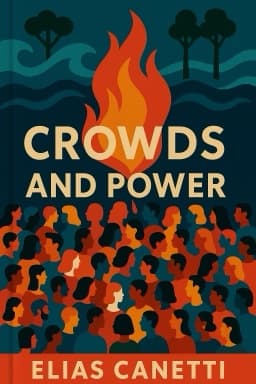
From Fear to Frenzy: The Hidden Science of Crowds and Power You Never Learned in School
A compelling exploration of how crowds form, grow, and wield power — with surprising examples from history and nature.

Most of us think of crowds as unpredictable and irrational, but beneath the surface lies a complex science of human behavior. Elias Canetti’s Crowds and Power takes us on a journey through this hidden world, revealing the primal mechanisms that govern mass gatherings.
At the heart of crowd formation is the fear of touch — a basic human instinct to avoid unknown contact. Yet, paradoxically, crowds grow by overcoming this fear, pressing individuals into a shared body. This transformation culminates in the discharge, a moment of collective liberation when social distinctions vanish.
Canetti’s distinction between open and closed crowds explains why some gatherings explode suddenly and vanish, while others endure through ritual and boundaries. Open crowds are like wildfires, spreading rapidly but fleeting, while closed crowds are carefully contained, ritualized, and permanent.
Destruction is a recurring theme. Crowds attack windows, doors, and statues not simply to cause damage but to symbolically break down barriers that separate people. Fire becomes a metaphor for this process — uncontrollable, contagious, and transformative.
The emotional types of crowds — from baiting to feast — reveal the diverse motivations behind collective behavior, from primal instincts to cultural rituals. Rival double crowds sustain each other through opposition, fueling conflicts and wars that shape history.
Finally, Canetti’s exploration of rulers uncovers the psychological toll of power, where paranoia and fear dominate. Rulers are survivors trapped in a cycle of suspicion, reflecting the crowd’s own anxieties.
By understanding these dynamics, we gain insight into the forces that drive political movements, social unrest, and cultural celebrations today.
Want to explore more insights from this book?
Read the full book summary