
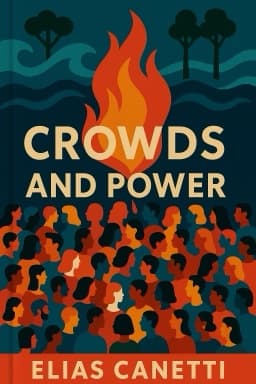
Unlocking the Secrets of Crowds: How Elias Canetti’s Masterpiece Reveals the Hidden Power of Masses
Discover the profound insights behind crowd behavior and the mysterious forces that drive collective human action.

Imagine a world where the invisible threads of human connection and fear weave vast tapestries of collective energy. This is the world that Elias Canetti opens to us in his seminal work, Crowds and Power. At its core, the book explores the paradox of human crowds: how they emerge from deep-seated fears, especially the fear of touch, yet transform that fear into a powerful unity that transcends individuality.
Canetti begins by revealing the primal human fear of the unknown touch — a survival instinct that shapes social behavior and personal boundaries. Yet, when individuals find themselves pressed tightly in a crowd, this fear reverses into a sensation of shared identity and equality. The crowd becomes a single body, pulsating with collective emotion. This moment of unity, called the discharge, is the birth of the crowd’s power, where social distinctions vanish and a fleeting equality is felt.
But crowds are not monolithic. Canetti distinguishes between open crowds that grow without limits, absorbing anyone nearby, and closed crowds that establish boundaries to maintain permanence and order. This distinction explains why some crowds erupt spontaneously and dissipate quickly, while others endure through rituals and repeated gatherings.
One of the most compelling aspects of Canetti’s work is his analysis of the crowd’s darker side. The urge to destroy — smashing windows, tearing down statues, setting fires — is not mere chaos but a symbolic attack on boundaries that separate individuals. Fire, in particular, emerges as a powerful metaphor for the crowd’s contagiousness and insatiability, capable of both destruction and renewal.
Further enriching his analysis, Canetti identifies five emotional types of crowds — from the primal baiting crowd focused on killing, to flight crowds driven by fear and escape, to uniquely human prohibition, reversal, and feast crowds. These typologies reveal the complex social and cultural forces that shape collective behavior.
Perhaps most fascinating is Canetti’s concept of the double crowd — opposing crowds that sustain each other through rivalry. Whether men and women, living and dead, or enemies in war, these oppositions create dynamic tension that fuels social and political conflicts.
Finally, Canetti delves into the psychology of rulers and paranoiacs, uncovering how the exercise of power is inseparable from fear and suspicion. Rulers are survivors haunted by paranoia, reflecting the crowd’s own anxieties and the precarious balance between authority and chaos.
Through vivid examples ranging from ancient executions to modern revolutions, Canetti’s work remains a timeless guide to understanding the forces that shape human societies. This blog has sought to capture the essence of his insights, inviting you to explore the mysterious and potent world of crowds and power.
For those eager to dive deeper, consider how these ideas resonate in today’s political rallies, social movements, and digital crowds. The primal dynamics Canetti describes continue to pulse beneath the surface of modern life, waiting to be understood and harnessed.
Want to explore more insights from this book?
Read the full book summary