
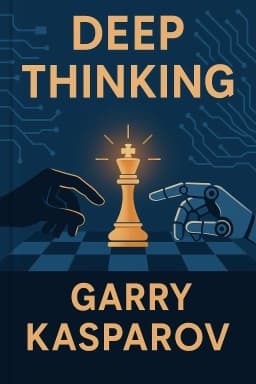
Advanced Chess: When Humans and Machines Join Forces to Dominate the Game
How blending human intuition with AI calculation is revolutionizing chess and beyond

Imagine a chess match where a human grandmaster sits side-by-side with a powerful computer, jointly analyzing positions and crafting moves that neither could achieve alone. This is the essence of Advanced Chess, a revolutionary concept introduced in 1998 that redefined the boundaries between human creativity and machine calculation.
Advanced Chess allows players to consult computers during games, harnessing the computational power of AI while retaining human intuition and strategic insight. These hybrid teams, often called 'centaurs,' have demonstrated remarkable success, outperforming both humans and machines playing alone.
This collaboration transforms not only competitive play but also how players train and prepare. Access to instant computer analysis enables deeper exploration of openings, tactics, and endgames, accelerating learning and creativity. Moreover, Advanced Chess challenges traditional notions of competition, emphasizing partnership and augmentation over rivalry.
Beyond the chessboard, Advanced Chess symbolizes a broader paradigm shift in human-machine interaction. It illustrates how blending strengths can unlock new possibilities in diverse domains—from medicine to engineering—where AI supports rather than replaces human expertise.
As technology continues to evolve, embracing such collaborative models offers a hopeful path forward, where humans and machines together push the frontiers of knowledge and achievement.
For further reading, explore Kasparov’s reflections on AI augmentation and Chessiverse’s insights on centaur chess teams.
3 2
Want to explore more insights from this book?
Read the full book summary