
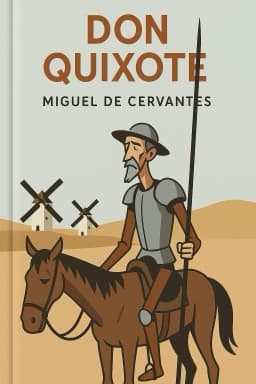
Unpacking Don Quixote: How a Mad Knight Changed Literature Forever
Discover the groundbreaking narrative techniques and cultural impact of Cervantes' masterpiece.

When Miguel de Cervantes published Don Quixote in the early 1600s, he did more than tell the tale of a deluded knight and his loyal squire. He crafted a work that would forever alter the landscape of literature.
One of the novel’s most remarkable features is its narrative complexity. Cervantes employs multiple layers of storytelling, where characters read about themselves and comment on their own adventures. This metafictional approach was groundbreaking, inviting readers to engage with the text on a deeply self-aware level.
The novel also blends irony, parody, and realism in ways that challenge traditional literary forms. It questions the nature of reality and fiction, blurring the boundaries between the two. Through Don Quixote’s madness and Sancho’s pragmatism, Cervantes explores themes of identity, perception, and the human desire for meaning.
Historically, the novel reflects the cultural and political tensions of Spain’s Golden Age. Cervantes critiques social hierarchies, religious dogma, and the decline of chivalric ideals, all wrapped in humor and satire. The burning of chivalric books within the story symbolizes the conflict between old and new ideas, a metaphor for the societal transformations of the time.
Don Quixote’s influence extends far beyond Spain. His adventures have inspired writers such as Charles Dickens, James Joyce, and Jorge Luis Borges. The novel’s innovative narrative techniques laid the foundation for the novel as a literary form, shaping how stories are told across cultures and centuries.
Understanding Don Quixote’s impact is key to appreciating the evolution of literature. It is a work that invites readers not only to enjoy a compelling story but to reflect on the very nature of storytelling itself.
For students, scholars, and lovers of literature, Don Quixote remains a vital touchstone — a story that continues to challenge, entertain, and inspire.
Sources: EssayPro Don Quixote Summary [[1]](#__1); John Manders' Blog [[0]](#__0); Media on My Mind [[3]](#__3)
Want to explore more insights from this book?
Read the full book summary