
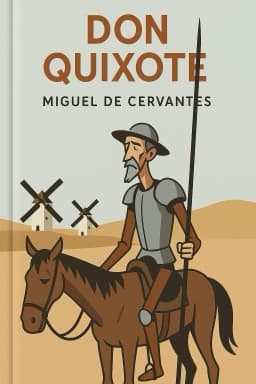
Why Don Quixote Still Captivates the World: The Timeless Tale of Idealism and Madness
Explore how a 400-year-old story about a mad knight and his loyal squire continues to inspire readers worldwide.

Few literary works have endured the test of time quite like Don Quixote. Written by Miguel de Cervantes over 400 years ago, this novel is often heralded as the first modern novel, a masterwork that combines humor, tragedy, and profound insight into the human condition. But what is it about the story of a deluded knight and his simple squire that continues to resonate with readers across the globe?
At its core, Don Quixote is a story of idealism — the desire to live by noble principles in a world that often seems indifferent or hostile to such ideals. Alonso Quixano, a middle-aged man from La Mancha, becomes so enamored by tales of chivalry that he renames himself Don Quixote and sets out to revive knighthood. His transformation is both a personal awakening and a poignant commentary on the power of literature and imagination.
Don Quixote’s adventures, from mistaking windmills for giants to attacking puppet theaters, reveal a world where fantasy and reality collide. These misadventures are not only sources of comedy but also lenses through which Cervantes critiques the social and cultural norms of his time. The novel satirizes the rigid social hierarchies, religious hypocrisy, and the decline of chivalric ideals during Spain’s Golden Age. It is a mirror reflecting a society in flux, struggling with change and the loss of old values.
Central to the story is the unique bond between Don Quixote and his squire, Sancho Panza. Sancho’s earthy pragmatism contrasts with his master’s lofty idealism, creating a dynamic interplay of perspectives. Their friendship evolves beyond master and servant into a brotherhood that embodies the tension between dreams and reality, hope and experience.
One of the novel’s most innovative aspects is its narrative complexity. Cervantes employs metafictional techniques, where the story comments on itself, blurring the lines between fiction and reality. The Cave of Montesinos episode, for example, is a surreal journey that invites readers to question the nature of storytelling and consciousness.
The legacy of Don Quixote is immense. It laid the foundation for the modern novel, influencing countless authors from Dickens to Joyce. The term 'quixotic' has entered our language to describe noble but impractical idealism, a testament to the enduring power of Cervantes’ creation.
Ultimately, Don Quixote teaches us about the resilience of the human spirit. It encourages us to embrace our dreams and face life’s challenges with courage and humor.
Whether you see Don Quixote as a madman, a dreamer, or a hero, his story invites reflection on what it means to live a meaningful life. It is a celebration of imagination, friendship, and the eternal quest for justice and beauty.
For anyone seeking inspiration or a deeper understanding of literature’s power, Don Quixote remains a vital and enriching journey.
Sources: John Manders' Blog on Don Quixote [[0]](#__0); EssayPro Summary and Analysis [[1]](#__1); Sarah M. Sutherland’s Media on My Mind [[3]](#__3)
Want to explore more insights from this book?
Read the full book summary