
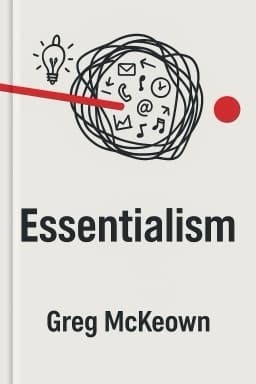
Why Saying No Could Be Your Ultimate Superpower: The Essentialism Revolution
Discover how mastering the art of saying no transforms your life and work.

Have you ever felt overwhelmed by the sheer volume of demands on your time? The constant barrage of emails, meetings, social obligations, and endless to-do lists can leave even the most organized person feeling exhausted and scattered. Yet, what if the key to a richer, more fulfilling life lies not in doing more but in deliberately choosing less?
Welcome to the world of Essentialism. This philosophy is a disciplined pursuit of less but better. It starts with a simple yet profound understanding:
Many people suffer from what psychologists call 'learned helplessness,' where past experiences of powerlessness cause them to say yes to everything, not because they want to but because they feel they have no alternative. Recognizing this helps us reclaim our freedom to choose and say no with grace and clarity.
One of the foundational principles of Essentialism is the Pareto Principle — the idea that roughly 20% of your efforts produce 80% of your results. This means that most of what we do daily is trivial, and only a small fraction truly moves the needle. Imagine a young paperboy who discovered washing cars made him six times more money per hour than delivering papers. By focusing on the vital few, he transformed his earnings and learned a lifelong lesson about prioritization.
But focusing on less requires embracing trade-offs. Success is not about doing everything but about choosing which problems you want to solve. An airline that chooses to fly only point-to-point routes and serve no meals sacrifices some offerings but achieves profitability and customer loyalty. Meanwhile, competitors trying to do everything end up inefficient and confused.
Creating space for deep thinking and reflection is another essential step. In our hyperconnected world, solitude is rare but necessary for clarity and creativity. Executives who retreat to quiet spaces without phones or internet find renewed focus and breakthrough ideas. This practice combats decision fatigue and restores mental clarity.
Seeing clearly amid the noise involves filtering distractions and journaling to track patterns and insights. Journals act as external memory, helping us connect dots invisible in daily chaos and enabling thoughtful responses rather than reactive ones.
Embracing play is surprisingly powerful. Play reduces stress, activates executive brain functions, and fuels creativity. Many innovators credit playful experimentation for their breakthroughs, reminding us that creativity thrives when we allow ourselves freedom and curiosity.
Finally, protecting your sleep is not a luxury but a foundation for sustained productivity and well-being. Adequate rest enhances decision-making, creativity, and memory consolidation, while lack of sleep impairs judgment and focus. Top performers prioritize sleep as a critical investment in their success.
In essence, Essentialism invites you to live a life of meaning, impact, and joy by focusing on less but better. By reclaiming your power to choose, discerning what truly matters, embracing trade-offs, creating space for reflection, seeing clearly, playing freely, and protecting your rest, you unlock your full potential.
Start your Essentialist journey today — say no to the trivial many and yes to the vital few.
Want to explore more insights from this book?
Read the full book summary