
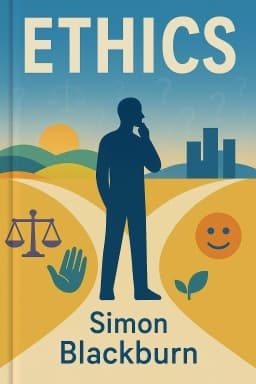
7 Surprising Ways ‘Being Good’ Can Transform Your Everyday Life (That Most People Miss!)
Unlock the Hidden Power of Everyday Morality with Lessons from Simon Blackburn

Unlock the Hidden Power of Everyday Morality with Lessons from Simon Blackburn
Have you ever wondered why some people seem to carry a quiet confidence—an ease with themselves and the world—while others are racked with doubts about right and wrong? Simon Blackburn’s ‘Being Good’ isn’t just another ethics book; it’s a roadmap for anyone who wants to understand, and actually practice, goodness in a world that often feels morally confusing.
1. The Invisible Climate of Morality
Blackburn opens with a powerful metaphor: just as we breathe air, we live within an ‘ethical climate’—a web of stories, standards, and expectations that shape what we admire or despise. Most of us never notice how much our moral instincts are shaped by our surroundings. For example, think about how attitudes toward honesty, loyalty, or tolerance have shifted over generations. Blackburn shows that by becoming aware of our ethical climate, we can start to question it, and even change it for the better.
2. The Seven Shadows: Why We Doubt Morality
Why do so many smart people end up cynical about ethics? Blackburn explores seven ‘threats’—from the decline of religious authority to the rise of relativism, egoism, and evolutionary explanations for behavior. He argues that while skepticism has its place, it can also lead to paralysis or indifference. Instead, we need to find a path between rigid dogmatism and moral apathy, using reason and empathy as our guides.
3. Birth, Death, and Meaning: Ethics at the Edges
Some of the hardest moral questions arise at the edges of life—when we think about abortion, end-of-life care, or what makes life meaningful. Blackburn urges us to resist easy slogans and instead embrace complexity. For instance, he highlights the concept of ‘gradualism’ in debates about abortion: moral status isn’t an on/off switch, but something that grows over time. Similarly, he reassures us that death, though often feared, is not an evil to the one who dies, echoing ancient wisdom from Epicurus and others.
4. Pleasure, Happiness, and the Art of Flourishing
What’s the difference between a life of fleeting pleasure and true happiness? Blackburn draws on Aristotle and Mill to show that happiness is more than a string of pleasant experiences—it’s about living well, cultivating virtue, and engaging deeply with the world. He asks us to consider: would you rather be a contented pig or a dissatisfied philosopher? Most of us, he suggests, would choose the latter, because meaning matters more than mere sensation.
5. Rules, Duties, and the Common Good
How should we decide what’s right? Blackburn compares three classic ethical theories: utilitarianism (the greatest good for the greatest number), deontology (duty and universal law), and virtue ethics (the character of the person acting). Each has its strengths and pitfalls, but together they offer a toolkit for navigating complex moral landscapes. Blackburn encourages us to draw on all three, rather than seeking a one-size-fits-all answer.
6. Freedom, Rights, and Justice
Modern life is full of competing claims about rights and freedoms. Blackburn warns against ‘rights inflation’—the tendency to call every demand a right—which can make meaningful justice harder to achieve. He distinguishes between negative liberty (freedom from interference) and positive liberty (the power to act), and reminds us that justice is about more than fairness; it’s about balancing individual dignity with the needs of the many.
7. The Hope of Moral Progress
Perhaps the most hopeful lesson in ‘Being Good’ is that moral progress is possible. Blackburn points to historical advances—like the abolition of slavery and the expansion of rights—as evidence that we can improve, even if slowly and imperfectly. He ends with a call to see ethics as a shared conversation, a journey we walk together, always questioning, always learning, always striving for a better world.
In the end, ‘Being Good’ is a book about hope: the hope that by thinking, feeling, and acting together, we can make the world a little kinder, a little fairer, and a lot more meaningful—starting with the choices we make every day.
Want to explore more insights from this book?
Read the full book summary