
Why Most People Miss the True Meaning of Midlife (And How to Find It)
Unlock the hidden spiritual tasks of the second half of life and why your first half was just the beginning.

Midlife is often portrayed as a crisis—a time of confusion, loss, and despair. But what if it is actually an invitation to something greater? In his groundbreaking work, James Hollis explores the two halves of life, revealing that the first half is dedicated to building the container of identity, while the second half calls us to enter the unknown and find deeper meaning.
The first half of life is about establishing security: career, family, social roles, and ego boundaries. We learn to navigate the world through law, tradition, and authority, creating a 'loyal soldier' within — an inner voice that guards our identity. However, this container is not the final destination. Many spend decades here, mistaking the container for the treasure.
Then comes the call to adventure — the hero's journey — which compels us to leave the familiar and face the sacred wound. This wound, whether loss, failure, or suffering, is a catalyst for transformation. It breaks the ego's grip and opens the soul to new depths.
Embracing suffering is not about masochism but about recognizing it as a spiritual doorway. It teaches humility, compassion, and the paradox that weakness can be strength. The 'tragic sense of life' acknowledges that contradictions and loss are not aberrations but the fabric of existence.
Through these trials, we become homesick for a deeper belonging — not to a physical place but to the soul's true home. This longing guides us toward awakening, dissolving spiritual amnesia and revealing the True Self. Awakening leads to unity consciousness, authentic living, and compassion beyond ego.
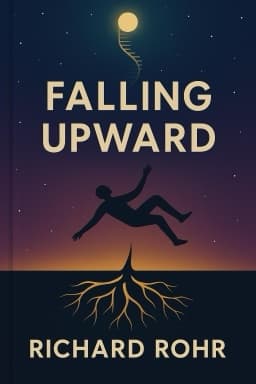
Understanding and embracing the two halves of life can transform midlife from a crisis into a profound journey of growth and meaning. It invites us to fall upward — to lose ourselves in order to find our true selves.
This journey is supported by insights from Jungian psychology, clinical experience, and timeless wisdom. It is a path open to anyone willing to embrace change, suffering, and the mystery of life.
For more detailed explorations, see sources such as ExploreThatBook, Me and Jorge, and Jonah Calinawan for comprehensive reviews and reflections. 1 3 4
Want to explore more insights from this book?
Read the full book summary