
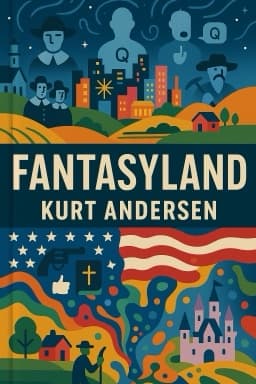
How America Lost Its Grip on Reality: The 500-Year Fantasyland Saga
Dive Deep Into the Roots of America’s Love Affair with Fantasy and What It Means Today

America’s story is unlike any other. It is a tale woven with threads of hope, imagination, and a peculiar penchant for fantasy that has shaped its cultural DNA for over five centuries. Kurt Andersen’s Fantasyland masterfully charts this journey, revealing how the nation’s foundational values of individualism and religious freedom birthed a culture where subjective belief often eclipses objective reality.
The roots stretch back to the 17th century, where Puritan zealotry and the Protestant Reformation’s empowerment of personal Bible interpretation laid the groundwork for a society that prizes personal conviction. Early settlers chasing fool’s gold in Jamestown and embracing apocalyptic visions of America as a "city upon a hill" set a precedent for hopeful fantasy in the face of harsh realities.
Fast forward to the Great Awakenings of the 18th and 19th centuries, and we see emotional religious revivals transforming faith into a visceral experience. Camp meetings with thousands of ecstatic participants, preachers employing theatrical sermons, and physical manifestations of spirituality like 'the jerks' created a uniquely American evangelical fervor.
In the 19th century, figures like Joseph Smith introduced new religious narratives that blended folk magic with revelation, positioning America as the new Holy Land. This era also witnessed a cultural delirium where pseudoscience, showmanship, and utopian experiments blurred fact and fantasy, exemplified by P.T. Barnum’s American Museum and widespread belief in phrenology.
The 20th century brought a paradoxical legacy of the Enlightenment: while reason and science flourished, freedom of belief allowed irrational ideas to persist. The rise of mass media further complicated perceptions of truth, blending entertainment with news and shaping public consciousness.
Then came the cultural explosion of the 1960s and ’70s, where the hippie movement’s spiritual syncretism and evangelical political mobilization transformed America’s spiritual and political landscape. Mass media amplified competing realities, setting the stage for the digital age’s fantasy-industrial complex.
Today, media and technology merge to create immersive fantasy worlds, from reality TV to virtual reality, while the internet democratizes belief, allowing niche fantasies and conspiracy theories to flourish globally. This has culminated in a post-truth era marked by political polarization, misinformation, and the mainstreaming of conspiracy theories.
Understanding this complex history is crucial to navigating contemporary challenges. Andersen’s Fantasyland not only chronicles America’s cultural evolution but also serves as a call to recognize the power of belief and the importance of reclaiming a shared reality. As we confront the political consequences of this fantasy embrace, the future of American democracy hangs in the balance.
For a deeper dive into the book’s themes and historical insights, check out reviews and analyses from sources like Seeking Alpha, The National Book Review, and Bookey, which offer varied perspectives on Andersen’s compelling narrative.
Sources:
1
,
2
,
3
Want to explore more insights from this book?
Read the full book summary