
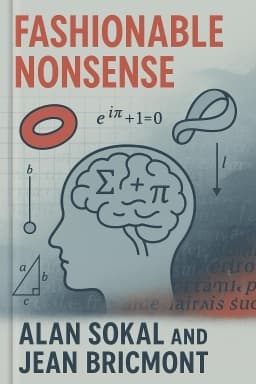
Chaos Theory and Fractals: Science’s True Mysteries vs. Postmodern Myths
Separate fact from fiction in the popular but often misunderstood concepts of chaos and fractals within scientific and cultural discourse.

Chaos theory and fractal geometry have captured the imagination of scientists and the public alike, revealing complex patterns and unpredictable behaviors in natural systems. Yet, their popular interpretations often stray far from scientific accuracy, especially within some postmodern narratives.
At its core, chaos theory describes deterministic systems that exhibit sensitive dependence on initial conditions, meaning tiny differences in starting points can lead to vastly different outcomes. This challenges simple notions of predictability but does not imply randomness or the absence of underlying laws.
Fractal geometry reveals self-similar structures repeating at different scales, creating infinitely intricate patterns from simple mathematical rules. These discoveries have profound implications across disciplines, from weather forecasting to biology.
However, postmodern discourse sometimes exaggerates these ideas, suggesting that chaos and fractals prove radical uncertainty or undermine objective knowledge. Such interpretations misrepresent the science and blur the line between metaphor and empirical fact.
Understanding the true nature of chaos and fractals enriches our appreciation of complexity without succumbing to intellectual confusion.
For readers fascinated by the crossroads of science and philosophy, this article offers a clear-eyed perspective on these captivating phenomena.
Sources: Wikipedia, academic critiques, Merion West review 1 3
Want to explore more insights from this book?
Read the full book summary