
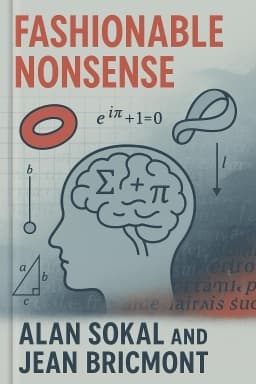
Topology, Poetry, and Postmodern Confusion: When Math Meets Metaphor
Explore the curious and often problematic ways complex mathematics have been used to explain mind and language in postmodern thought.
The allure of mathematics lies in its precision and elegance, yet when complex mathematical ideas cross into the realms of psychoanalysis and poetry, the results can be both fascinating and perplexing. This blog delves into how topology—the study of properties preserved under continuous deformations—and set theory have been invoked to explain mental structures and poetic language within postmodern discourse.
Psychological theories have sometimes described neurosis using topological shapes such as the torus or Möbius strip. These metaphors suggest mental phenomena possess complex, intertwined structures. However, the explanations often lack empirical grounding or clear conceptual clarity, reflecting a superficial use of mathematical language that impresses more than it informs.
Similarly, literary theorists have attempted to formalize poetic language through set theory, invoking notions like infinite cardinalities and the axiom of choice. These efforts frequently confuse metaphorical analogy with rigorous mathematical application, leading to misinterpretations. Gödel’s incompleteness theorems, which reveal fundamental limits in formal systems, are sometimes misused to argue about the nature of poetic meaning, demonstrating a misunderstanding of their actual significance.
These examples underscore the challenges of interdisciplinary borrowing. Metaphors enrich understanding but must be employed with care to avoid intellectual muddle. Clear distinctions between metaphor and literal scientific claims are essential to maintain rigor and prevent confusion.
For scholars and enthusiasts alike, this exploration offers a cautionary tale about the seductive power of complex language and the importance of intellectual honesty when bridging disciplines.
Sources: Wikipedia, Amazon reviews, scholarly critiques on postmodern science misuse 2 3 4
Want to explore more insights from this book?
Read the full book summary