
Unmasking the Intellectual Follies: How Postmodernism Misuses Science
Dive deep into the fascinating world where science meets postmodernism and uncover the intellectual missteps that have stirred controversy for decades.

In the ever-evolving landscape of ideas, few topics have sparked as much debate as the relationship between postmodernism and science. At the heart of this discourse lies a provocative critique: the misuse of scientific and mathematical language by some postmodern intellectuals to cloak their ideas in an aura of profundity. This blog delves into the intricate arguments laid out in a seminal work that brought these issues to light, revealing the fascinating yet troubling interplay between intellectual authority, confusion, and the quest for knowledge.
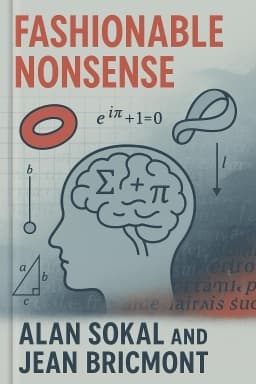
One landmark event that crystallized these concerns was the Sokal hoax, where a deliberately nonsensical article laden with scientific jargon was accepted by a cultural studies journal. This moment exposed how intellectual fashion and authority can sometimes mask confusion and absurdity, leading to the acceptance of ideas not on their merit but on their prestige or obscurity. It serves as a cautionary tale against the blind reverence of authority and the seductive power of obscure language.
Building on this foundation, the book scrutinizes the curious case of topology in psychoanalysis. Complex mathematical shapes like the torus and Möbius strip were invoked as metaphors for mental structures without clear empirical support or coherent explanation. Such misuse highlights a superficial engagement with mathematics, aimed more at impressing than illuminating.
Further, attempts to formalize poetic language through set theory and logical constructs reveal a similar pattern of intellectual posturing. The invocation of infinite cardinalities and the axiom of choice, alongside misinterpretations of Gödel’s incompleteness theorems, underscore the dangers of confusing metaphor with rigorous analogy. These examples illustrate how borrowing scientific concepts without proper grounding can lead to intellectual confusion rather than clarity.
This critique extends into philosophical reflections on skepticism and the nature of scientific knowledge. While radical skepticism questions all knowledge claims, the practical approach favors science as the best approximation to truth, supported by empirical evidence and rational methods. The dynamic nature of scientific testing, involving complex webs of assumptions and paradigm shifts, further complicates simplistic views of falsifiability, emphasizing science’s nuanced and evolving character.
Moreover, the discussion highlights the human elements of science—creativity, intuition, and social context—that defy rigid methodological prescriptions. Methodological pluralism and anarchism advocate for flexibility and diversity in scientific practice, recognizing that breakthroughs often arise from creative disruption rather than strict adherence to rules.
The sociology of science adds another layer, exploring how social constructs influence knowledge production while emphasizing the indispensable role of empirical reality. Ignoring nature’s constraints risks slipping into relativism, undermining the foundations of scientific inquiry.
In the realm of modern science, chaos theory and fractals have been misappropriated in postmodern discourse, often exaggerated to imply radical uncertainty or relativism. Understanding their true deterministic yet unpredictable nature is essential to avoid these misconceptions.
The critique also addresses feminist perspectives on science, cautioning against misunderstandings and superficial claims that conflate metaphor with literal scientific concepts. Clear communication and intellectual honesty are vital to bridging social critique and scientific accuracy.
Ultimately, the message is a call for clarity, rigor, and respect across disciplines. Intellectual honesty and transparent communication are the best defenses against the misuse of science and the erosion of rational discourse. Like a lighthouse cutting through fog, these qualities guide us toward genuine understanding and progress.
For those fascinated by the intersection of science, philosophy, and culture, this exploration offers a rich, thought-provoking journey through the challenges and triumphs of intellectual inquiry.
Explore more about this topic and its implications for contemporary thought and scholarship, and join the ongoing conversation about the boundaries and bridges between disciplines.
Sources: Merion West review, Wikipedia, Amazon customer insights on 'Fashionable Nonsense' 1 3 4
Want to explore more insights from this book?
Read the full book summary