
Why Time Feels Like It’s Racing: The Hidden Science Behind Your Perception of Time
Discover the surprising reasons why your days seem shorter as you age and how your brain’s inner clocks shape your experience of time.

Have you ever felt like the years are slipping away faster than before? That childhood summers felt endless, but now weeks blur by in a flash? This sensation is more than just nostalgia; it reflects the complex interplay of brain rhythms, memory, and emotional states shaping our perception of time.
The Power of Waiting and Delayed Gratification
One of the foundational insights into time perception comes from the famous Marshmallow Test. Children were given a choice: eat one marshmallow immediately or wait and receive two later. Those who could delay gratification tended to have better academic and social outcomes years later. This ability to wait reflects an expanded temporal horizon — the capacity to look beyond the immediate moment toward future rewards. It’s a cornerstone of emotional intelligence and self-control, deeply influencing how we experience time in daily life.
The Brain’s Rhythms: Our Internal Timekeepers
Our conscious experience isn’t continuous but segmented into discrete steps by brain oscillations, especially gamma waves around 40 Hz. These oscillations create temporal windows of perception, roughly 20 to 60 milliseconds apart, enabling us to discern the order of events in time. Imagine your brain taking rapid snapshots and stitching them into seamless experience. Disruptions in these rhythms can cause time distortions, such as the sensation of time speeding up or slowing down in neurological conditions.
The Present Moment: The Three-Second Window
Our experience of 'now' is naturally segmented into units lasting about two to three seconds. This temporal integration window structures speech, music, and even visual perception. For example, when looking at ambiguous images, our brain flips interpretations every three seconds or so. This rhythm is echoed in our breathing and bodily awareness, forming the heartbeat of presence and mindfulness.
Biological Clocks and the Flow of Days
Beyond milliseconds and seconds, our bodies operate on a circadian rhythm — a roughly 24-hour internal clock regulating sleep, mood, and cognition. This rhythm persists even without external cues and is foundational to our daily experience of time. However, modern life often clashes with this biological pulse, causing phenomena like social jetlag, where natural sleep patterns conflict with social schedules, leading to fatigue and health issues.
Why Time Speeds Up as We Age
Adults often report that time seems to pass faster compared to childhood. This acceleration is linked to routine and memory: novel and emotional experiences create dense memories that stretch subjective time, while repetitive days lack these markers, making time feel compressed. This explains why vacations feel longer in memory than workweeks. The paradox is that while waiting, time drags, but in hindsight, uneventful periods seem short.
The Self and Time
Our identity is deeply tied to how we perceive time. The narrative self weaves past, present, and future into a coherent story, supported by working memory that bridges discrete moments. The insular cortex integrates bodily signals, grounding our sense of self and temporal awareness. Without this integration, time and self can fragment, impacting our experience profoundly.
Emotions Color Our Temporal Experience
Emotions stretch or shrink our perception of time. Fear dilates time, making moments feel longer to prepare us for survival. Joy can make time fly or linger depending on context, while boredom makes time drag painfully. Understanding these emotional modulations helps us manage our experience of time and live more fully.
Mindfulness: The Art of Slowing Time
Mindfulness practices deepen presence and slow subjective time, reducing stress and enhancing emotional regulation. Regular practice reshapes brain regions involved in attention and temporal awareness, helping us savor life’s fleeting moments with greater richness.
Body Time: The Physical Pulse of Experience
Our bodily rhythms — heartbeat, breath, and interoceptive signals — shape how we experience time. The insular cortex processes these signals, creating a unified sense of presence. Changes in bodily states, such as pain or emotional arousal, alter our temporal perception, underscoring the embodied nature of time.
Embracing Time for a Fulfilling Life
Ultimately, embracing the flow of time with awareness and acceptance fosters peace and emotional balance. A flexible temporal perspective integrating past, present, and future enriches meaning and supports purposeful living. Time is not an enemy but a companion guiding us through the journey of being.
Understanding the science and psychology of time perception empowers us to live more intentionally, savoring each moment and shaping our experience of life’s precious flow.
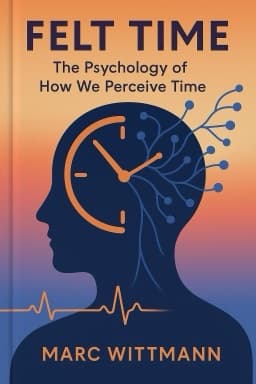
Sources: FiveBooks on Time and Mind, Felt Time by Marc Wittmann, Psychology of Time Perception
Want to explore more insights from this book?
Read the full book summary