
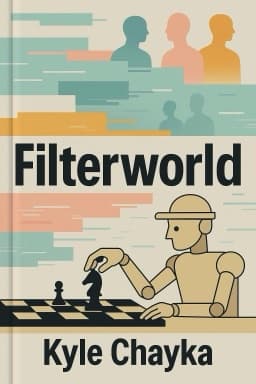
How Algorithms Secretly Control Your Life: The Shocking Truth Behind 'Filterworld'
Why Your Choices Aren’t Really Yours Anymore

Why Your Choices Aren’t Really Yours Anymore
Imagine waking up in a city you’ve never visited before. You find a coffee shop, and it feels oddly familiar: the same white tiles, the same potted plants, the same minimalist menu. You scroll through your phone, and every feed—whether music, news, or fashion—seems to echo the same tastes and trends. This is not a coincidence, Kyle Chayka argues in Filterworld; it’s the result of a vast, invisible network of algorithms shaping our lives in ways both subtle and profound.
Algorithms are as old as civilization, but their power has exploded in the digital era. Where once human curators—editors, DJs, critics—guided our cultural choices, now equations do the heavy lifting. Social media feeds are no longer chronological; they’re optimized for engagement, learning from every like, pause, and swipe. The result? A world where what’s popular gets more popular, and what’s unique is often drowned out.
This flattening of taste extends far beyond the screen. Physical spaces are now designed for 'Instagrammability,' prioritizing how they’ll look in a feed over genuine local character. The same viral jacket or TikTok dance can leap from New York to Tokyo overnight, not because of inherent quality, but because an algorithm decided to amplify it. Even our sense of self is at risk: influencers and everyday users alike feel pressured to optimize their identities for maximum engagement, leading to what Chayka calls 'algorithmic anxiety.'
Yet, the story isn’t all doom and gloom. Around the world, people are pushing back. Lawmakers are demanding algorithmic transparency. Creators are returning to manual curation—handpicked playlists, indie newsletters, and local meetups. Offline communities offer a richness and authenticity that algorithms struggle to replicate. The message is clear: while algorithms may set the stage, we can still choose how to act upon it.
'Filterworld' is a wake-up call and a roadmap for reclaiming agency in a digital age. It’s a book for anyone who has ever wondered why everything feels the same—and what we can do about it.
If you’ve ever felt the uncanny sense that your life is being curated for you, you’re not alone. And as Chayka shows, the first step to breaking free is simply to notice—to become your own curator once again.
Want to explore more insights from this book?
Read the full book summary