
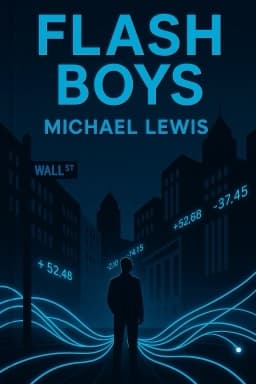
How High-Frequency Traders Hijack the Market – And The Heroes Fighting Back
A riveting look at the dark side of Wall Street’s speed obsession and the innovative fight for fairness.

High-frequency trading (HFT) is often described as the Wall Street arms race for speed. But what does that really mean? At its core, HFT firms use ultra-fast computers and specialized infrastructure to execute trades in microseconds, exploiting tiny delays in market data to jump ahead of other investors.
One of the most astonishing revelations is the construction of a secret, ultra-straight fiber-optic tunnel between Chicago and New Jersey. This tunnel shaved milliseconds off data transmission times, giving its owners a critical edge. Workers digging the tunnel were unaware of its purpose, highlighting the secrecy surrounding this race.
The market itself is fragmented into numerous public exchanges and private dark pools, where large trades can be hidden from public view. These dark pools, while intended to protect investors, often enable predatory practices by selling access to high-frequency traders who exploit incoming orders.
Complex order types and fee structures further complicate the landscape. Some orders hide from public view, others allow rapid cancellations, and many are designed to game the system. Exchanges incentivize certain routing behaviors through maker-taker fees, which can conflict with investors’ best interests.
A trader’s personal experience brought these issues to light. He found that the shares he tried to buy would vanish or cause price spikes, revealing that the market on his screen was an illusion. This discovery sparked a mission to build tools to fight back.
A telecom expert joined the fight, applying physics and engineering to understand the physical constraints of data transmission. He showed how even a few feet of extra cable or server placement within data centers could add microseconds of latency, exploited by high-frequency traders.
Together, the team developed Thor, an innovative algorithm that introduced deliberate delays to synchronize order arrivals across exchanges, preventing front-running. Real trades costing thousands of dollars a day validated this approach and demonstrated the costs imposed by predatory trading.
The Investors Exchange (IEX) was then created as a fair market alternative, implementing a fixed 350-microsecond delay and rejecting payments for order flow. Despite facing fierce resistance from established banks and exchanges, IEX’s principles of transparency and fairness gained support.
These revelations raise profound ethical questions about conflicts of interest, market transparency, and the human cost of a rigged system. Traders suffered stress and health issues, while most investors remained unaware of the predatory practices affecting their trades.
The battle for market fairness continues, fueled by hope and determination. The story of Flash Boys is a testament to how technology, ethics, and courage can intersect to challenge entrenched powers and restore trust.
References: Summary and analysis from The Investors Podcast 1 , Wikipedia overview 2 , Financial Pipeline review 3 , Alone With Books summary 4 .
Want to explore more insights from this book?
Read the full book summary