
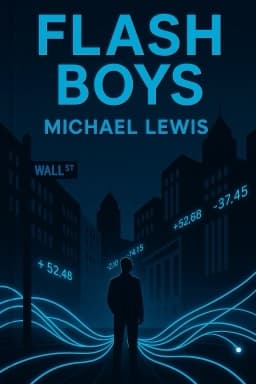
Inside the Secret Race for Wall Street’s Microseconds: What ‘Flash Boys’ Reveals About Market Rigging
Unveiling the hidden world where milliseconds mean millions and the fight to reclaim fairness in the stock market.

Imagine a world where a few thousandths of a second can mean the difference between making millions or losing everything. This is not science fiction but the reality of modern stock markets, as uncovered by Michael Lewis in his groundbreaking book, Flash Boys. The book pulls back the curtain on high-frequency trading (HFT), a practice where lightning-fast computers race to exploit tiny delays in data transmission to gain unfair advantages.
At the heart of this story is the construction of secret fiber-optic tunnels, designed to shave milliseconds off the time it takes for trade orders to travel between financial hubs like Chicago and New Jersey. These tunnels are no ordinary infrastructure projects; they represent an arms race for speed that has transformed the market into a playground for those who can afford the fastest connections.
The market itself is far from the transparent, level playing field it appears to be. Instead, it is fragmented across multiple public exchanges and private dark pools, where trades can be hidden and manipulated. Complex order types and fee structures further complicate the landscape, creating opportunities for predatory trading and information leakage.
One of the most compelling narratives in the book is the personal journey of a trader who discovers that the market he trusts is rigged against him. His orders disappear or cause price spikes, revealing how speed and information asymmetry undermine fairness. This revelation sparks a mission to build tools and an exchange that can fight back against these practices.
Enter the Thor algorithm, a revolutionary tool that introduced deliberate delays to synchronize order arrivals across exchanges, preventing high-frequency traders from jumping ahead. This counterintuitive approach demonstrated that slowing down could actually be the key to winning the speed race.
Building on this, the Investors Exchange (IEX) was created as a beacon of fairness, implementing a fixed 350-microsecond delay and refusing to accept payments for order flow. Despite facing fierce resistance from established banks and exchanges, IEX’s mission to restore transparency and protect investors gained momentum.
The book also raises profound ethical questions about the conflicts of interest pervasive in the market, the stress borne by traders, and the widespread ignorance among investors about the predatory practices affecting their trades. It challenges readers to consider what a just and equitable market should look like in the age of technology.
Ultimately, Flash Boys is a story of hope and determination, showing how a small group of individuals can challenge entrenched powers and inspire reform. It reminds us that markets should serve everyone, not just the fastest or most powerful.
Understanding this hidden race for speed and fairness is essential for anyone who participates in or cares about the financial markets. The insights from Flash Boys illuminate the complex interplay of technology, ethics, and finance, offering a roadmap for a more transparent and just future.
For investors, regulators, and curious minds alike, this exploration reveals the stakes of the high-speed market and the ongoing fight to ensure it works for all.
References: Summary and analysis from The Investors Podcast 1 , Wikipedia overview 2 , Financial Pipeline review 3 , Alone With Books summary 4 .
Want to explore more insights from this book?
Read the full book summary