
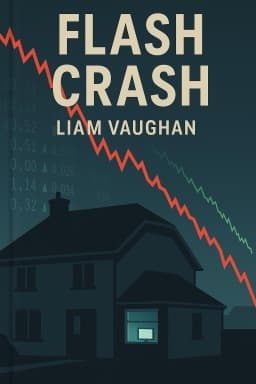
Inside the Flash Crash: How One Trader Shook Global Markets and Changed Trading Forever
A Deep Dive into the Shadowy World of Spoofing, High-Speed Trading, and the Market Meltdown That Shook Wall Street

Financial markets have always been a stage for human ambition, ingenuity, and sometimes deception. Yet few events have exposed their vulnerabilities quite like the Flash Crash. On a seemingly ordinary day, markets plunged precipitously within minutes, with some stocks trading for fractions of a cent before rebounding almost as quickly. This extraordinary event was not just a technical glitch but the culmination of decades of evolution in trading practices, technology, and regulatory oversight.
The story begins in the noisy, chaotic trading pits of the late 20th century, where traders shouted orders and used hand signals in a physical arena. These pits were social hubs where reputation and intuition mattered as much as capital. But as electronic platforms emerged, the trading landscape transformed dramatically. The rise of electronic order books replaced human brokers with algorithms, increasing speed and anonymity but eroding the social fabric that once defined markets.
Into this new world stepped high-frequency trading (HFT) firms, leveraging cutting-edge technology to execute trades in microseconds. By 2012, these firms accounted for over 60% of trades in major futures markets. The competition for speed led to massive investments in server colocation and fiber optic networks, creating an arms race that favored those with the fastest connections. While HFT provided liquidity and narrowed spreads, it also introduced new risks and complexities.
Among the tactics employed in this high-speed environment was spoofing—a deceptive practice involving placing large orders with no intention of execution to manipulate market perception. Spoofing has roots stretching back centuries but evolved into a sophisticated algorithmic strategy. One trader, working from a modest home office, developed customized spoofing algorithms using off-the-shelf software, featuring innovations like 'cancel if close' and 'back of the book' to minimize risk and maximize impact.
The trader's bold moves included exploiting overnight price divergences in European markets and placing massive trades during the 2008 financial crisis that netted millions in profits. These actions, while profitable, raised ethical and legal questions. The Flash Crash itself was a moment of systemic failure, where automated systems amplified volatility, some stocks briefly traded at near-zero prices, and liquidity vanished.
The ensuing global investigation was unprecedented in scope and complexity. Authorities tracked digital footprints across continents, culminating in the arrest of the trader—the first non-US citizen charged criminally with spoofing. This case set new precedents in cross-border enforcement and highlighted the challenges regulators face in policing algorithmic market manipulation.
In the aftermath, regulators implemented reforms like the Consolidated Audit Trail to improve transparency and oversight. Yet, the episode also revealed the psychological toll on traders and the fragile balance between technology and humanity in markets. As we look to the future, the lessons of the Flash Crash remind us that while machines execute trades at unimaginable speeds, it is human judgment, ethics, and resilience that ultimately shape the financial world.
Understanding this story is essential not only for traders and regulators but for anyone interested in the forces that drive modern markets and the ongoing struggle to ensure fairness and stability in an increasingly automated world.
Sources: Amazon and Goodreads summaries of "Flash Crash" by Liam Vaughan, academic insights on spoofing and market manipulation from Cambridge University, and financial journalism analyses of the Flash Crash event. 1 2 3 4
Want to explore more insights from this book?
Read the full book summary