
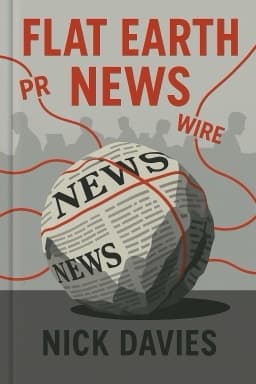
Inside the News Machine: How 'Flat Earth News' Reveals the Truth Behind Our Headlines
Discover the Hidden Forces That Shape What You Read Every Day

Discover the Hidden Forces That Shape What You Read Every Day
Imagine waking up to a world where every headline you read, every breaking news alert that pings your phone, and every front-page story is not the product of tireless investigation, but the outcome of a relentless, industrial process. This is the world Nick Davies uncovers in 'Flat Earth News,' a book that has shaken the foundations of journalism and forced both readers and reporters to confront uncomfortable truths about the information ecosystem that shapes our reality.
Davies begins by exposing the myth of news as a pure, unfiltered reflection of reality. Through painstaking research—including a landmark study of UK newspapers—he reveals that only a small fraction of stories are based on original reporting. The rest? They are 'churned'—copied, pasted, and repackaged from wire services, press releases, and the ever-expanding machinery of public relations. This phenomenon, dubbed 'churnalism,' is not a rare exception but the dominant mode of modern news production. The consequences are profound: errors go unchecked, PR agendas are disguised as facts, and the public is left with a distorted view of the world.
One of the most striking examples Davies explores is the global panic over the millennium bug. Media outlets, relying on unverified reports and sensational press releases, fueled fears of catastrophic technological failure. Governments and corporations spent billions in response, only for the crisis to pass with barely a ripple. This is not a one-off; similar cycles of misinformation have shaped public policy on everything from crime to health to international conflict.
But Davies does not stop at criticism. He traces the roots of the crisis to structural changes in the industry: the rise of corporate ownership, the collapse of local journalism, and the unrelenting pressure for speed and quantity over quality. Journalists, once valued for their expertise and skepticism, are now driven by impossible deadlines and shrinking resources. The result is a news environment where omission, not just commission, becomes the most powerful source of distortion.
Yet, amid this bleak landscape, there are glimmers of hope. Davies spotlights the resilience of investigative journalists who, against all odds, continue to dig, question, and expose the stories that matter. He also highlights the growing movement for media literacy, empowering readers to become active participants in the news process—questioning sources, identifying bias, and demanding accountability.
Ultimately, 'Flat Earth News' is both a warning and a call to action. It challenges us to look beyond the headlines, to interrogate the stories we are told, and to support the journalists and outlets that strive for truth. In an age of information overload and digital deception, this book is an essential guide for anyone who cares about democracy, accountability, and the future of honest reporting. 1 2 3
Want to explore more insights from this book?
Read the full book summary