
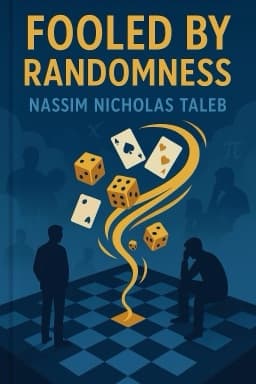
Are You Really in Control? How ‘Fooled by Randomness’ Reveals the Hidden Power of Luck
Unmasking the Illusion of Skill and Embracing the Role of Chance in Our Lives

Imagine walking into a bustling trading floor where fortunes are made and lost in the blink of an eye. The loudest voices, the flashiest cars, and the most extravagant lifestyles often belong to those who appear most skilled. But what if much of their success is a mirage, a shimmering illusion cast by the invisible hand of chance? This is the provocative core of Nassim Nicholas Taleb’s Fooled by Randomness, a book that peels back the layers of apparent mastery to reveal the profound influence of luck in our lives.
The book begins by contrasting two neighbors: one a flamboyant trader living a life of luxury, the other a cautious, steady dentist. While the trader’s wealth dazzles, it teeters on the edge of ruin, vulnerable to the hidden risks that luck conceals. Meanwhile, the dentist’s stable income, though less glamorous, offers a more reliable life path. This juxtaposition introduces a key insight: success is often less about skill and more about surviving the random storms that others cannot.
Taleb dives deep into the biological underpinnings of confidence, explaining how serotonin surges after success boost dominance behaviors and social status, regardless of actual ability. This biochemical feedback loop can mislead observers and the successful alike into mistaking luck for talent. Such insights challenge us to rethink how we evaluate achievement and credibility.
Moreover, the concept of alternative histories expands our perspective on outcomes. Every event is one thread in a vast web of possible paths, many of which remain unseen. The metaphor of Russian roulette, where survival is one of many potential fates, illustrates how our focus on winners blinds us to the many who failed under similar circumstances. This perspective urges caution in judging decisions solely by their results.
Monte Carlo simulations, pioneered during the Manhattan Project, provide a mathematical lens to simulate these alternative realities, revealing the spectrum of possible outcomes for complex systems like financial markets. These simulations help us visualize uncertainty and recognize the limitations of relying on single observed outcomes.
Yet, our minds are ill-equipped to grasp randomness fully. Cognitive biases, such as probability blindness and overconfidence, distort our perception of risk and chance. We tend to see patterns where none exist and underestimate rare but catastrophic events. Survivorship bias further compounds this illusion by spotlighting only the successes while ignoring countless failures, especially in high-risk domains like trading.
Philosophically, the problem of induction reminds us that past experience does not guarantee future results. Scientific knowledge advances through falsification and skepticism rather than certainty, underscoring the provisional nature of what we think we know.
Finally, Taleb encourages embracing uncertainty with stoicism and intellectual humility. By focusing on what we can control—our reactions and decisions—we cultivate personal elegance and resilience amid randomness.
“Fooled by Randomness” is more than a book about probability; it is a meditation on human fallibility, the limits of knowledge, and the wisdom of humility. It challenges us to look beyond the glittering surface of success and understand the complex dance of luck and skill that underlies our world.
Whether you are an investor, entrepreneur, or simply someone navigating life’s uncertainties, this book offers profound insights to help you see through the fog of randomness and live with greater clarity and grace.
Want to explore more insights from this book?
Read the full book summary