
The Mind’s Greatest Trick: How ‘Fooled by Randomness’ Explains Our Cognitive Blind Spots
Understanding Why We Misinterpret Chance and How to Outsmart Our Own Brains

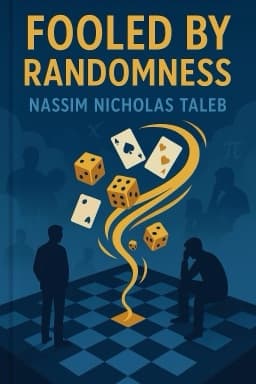
Our brains are remarkable organs, capable of incredible feats of reasoning and creativity. Yet, when it comes to understanding randomness, they play one of their greatest tricks on us: convincing us that we are in control when we are not. Nassim Nicholas Taleb’s Fooled by Randomness delves deep into the cognitive biases that distort our perception of chance and risk.
The book explains how our minds rely on heuristics—mental shortcuts—that simplify complex decisions but often lead us astray. For example, the representativeness heuristic makes us see familiar patterns in random data, while the availability heuristic causes us to overweight recent or vivid events.
Taleb highlights the dual-process theory of cognition: System 1, fast and intuitive, and System 2, slow and analytical. While System 1 helps us function efficiently, it is prone to errors in probabilistic reasoning. Engaging System 2 requires effort but is essential for overcoming probability blindness.
One striking example is how traders, after a series of wins, become overconfident due to serotonin’s effects on the brain. This biochemical boost masks the role of luck, leading to riskier bets and eventual ruin. Taleb’s insights into these psychological mechanisms explain why even experts fall prey to illusions of control.
By becoming aware of these cognitive blind spots, we can develop strategies to mitigate their impact. This includes embracing skepticism, questioning our intuitions, and using mathematical tools like Monte Carlo simulations to visualize uncertainty.
Whether you are navigating financial markets or making everyday choices, understanding your mind’s quirks can help you make wiser, more resilient decisions in an unpredictable world.
Want to explore more insights from this book?
Read the full book summary