
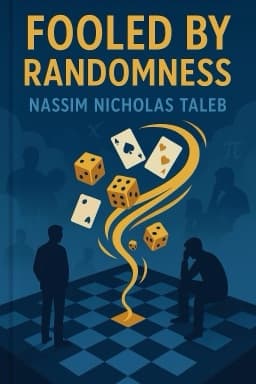
The Secret Science of Luck: How ‘Fooled by Randomness’ Changes Everything You Thought About Success
Exploring the Mathematical and Philosophical Foundations of Chance and Their Impact on Life

Luck is often relegated to the realm of superstition or dismissed as irrelevant to serious discussion. Yet, Nassim Nicholas Taleb’s Fooled by Randomness elevates luck to a central scientific and philosophical concept that reshapes how we understand success, risk, and knowledge.
The book introduces Monte Carlo simulations, a computational method developed during the Manhattan Project, to model the myriad possible futures that any event might take. This tool helps visualize the hidden variability behind observed outcomes and reveals why relying on single histories is misleading.
Taleb also discusses skewness and fat tails in probability distributions, showing that rare but extreme events disproportionately influence results. This insight explains phenomena like market crashes and the outsized impact of 'black swan' events.
Philosophically, the problem of induction reminds us that no amount of past data guarantees future predictions. Science progresses not by proving truths but by falsifying hypotheses and embracing skepticism. This epistemological humility is essential in a world dominated by randomness.
By integrating mathematics, philosophy, and real-world examples, Fooled by Randomness offers a comprehensive framework for understanding the secret science of luck. It challenges us to rethink success, embrace uncertainty, and cultivate resilience in the face of the unpredictable.
Whether you are a scientist, investor, or curious thinker, this book invites you to explore the fascinating interplay of chance and knowledge that governs our lives.
Want to explore more insights from this book?
Read the full book summary