
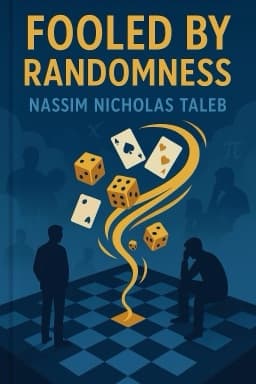
Why Most Success Stories Are Lies: The Hidden Role of Luck in ‘Fooled by Randomness’
Unveiling the Cognitive Illusions That Make Us Misjudge Success and Failure

We all love a good success story. The rags-to-riches entrepreneur, the market wizard who beats the odds, the genius who seems to have cracked the code of life. But what if these stories are largely illusions, crafted by the selective lens of luck and cognitive bias? Nassim Nicholas Taleb’s Fooled by Randomness offers a compelling and unsettling answer: most success is not what it seems.
At the heart of Taleb’s argument is survivorship bias—the tendency to focus on the winners while ignoring the multitude who fail. In the financial world, this means we hear about the spectacular gains of a few traders but rarely about the many who lost everything. This selective visibility inflates our perception of skill and underestimates the role of chance.
Taleb illustrates this with vivid examples, such as traders who enjoy a streak of wins and become overconfident, only to be wiped out by rare, unpredictable events. The surge of serotonin after success chemically boosts confidence, making the fortunate feel more competent than they truly are.
Another key insight is our probability blindness. Our brains are wired to find patterns and assign causality even where randomness reigns. We mistake noise for signal, leading to overconfidence and poor decision-making. Taleb’s exploration of Monte Carlo simulations shows how generating thousands of random sample paths reveals the true variability behind observed outcomes, challenging simplistic interpretations of success.
Philosophically, the book confronts the problem of induction—our flawed assumption that the future will resemble the past. Scientific progress, as Taleb notes, is not about proving truths but about falsifying hypotheses and remaining skeptical. This mindset is essential in a world dominated by uncertainty.
Ultimately, Fooled by Randomness is a call to humility. It warns against the seductive narratives of skill and control and encourages embracing uncertainty with stoicism and intellectual rigor. By understanding the hidden role of luck, we can make wiser decisions, avoid catastrophic risks, and live with greater peace of mind.
Whether you are an investor, manager, or seeker of truth, this book is a powerful reminder that the stories we tell ourselves about success often mask a deeper reality shaped by chance.
Want to explore more insights from this book?
Read the full book summary