
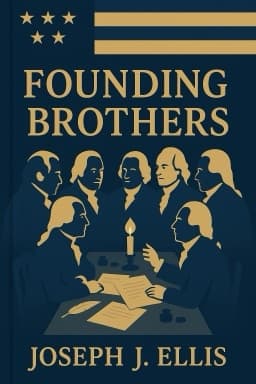
7 Secrets the Founding Fathers Never Told You: Lessons from 'Founding Brothers'
Discover the untold stories and profound lessons from America's revolutionary generation.

Discover the untold stories and profound lessons from America's revolutionary generation
The story of the American Revolution is often told as a straightforward march to destiny, but Joseph J. Ellis’s ‘Founding Brothers’ shatters that myth with remarkable insight and candor. Here, we reveal seven secrets—drawn from Ellis’s Pulitzer Prize-winning book and enriched by the latest historical scholarship—that will change how you see America’s founding forever.
Secret 1: The Revolution Was Never Inevitable
Most Americans imagine the birth of the nation as a foregone conclusion, but Ellis reveals that the odds were stacked against the founders at every turn. The Revolution was a leap into the unknown, with failure lurking at every step. Many of the leaders privately doubted their chances, haunted by the specter of defeat and British retribution. The founders’ triumph was less a product of destiny and more a testament to improvisation, courage, and luck.
Secret 2: Compromise Was the Real Miracle
Behind every major achievement lay a web of secret deals and personal negotiations. The famous Compromise of 1790, for instance, was struck at a private dinner where Jefferson, Hamilton, and Madison traded support for the federal assumption of state debts in exchange for locating the nation’s capital on the Potomac. This act of political artistry was not just about policy—it was about trust, rivalry, and the willingness to meet in the middle. Without such moments of give-and-take, the fragile union might have collapsed before it began.
Secret 3: Silence Was Sometimes a Strategy
One of the darkest secrets of the founding era was the conscious decision to defer the issue of slavery. The founders, fearing that honest debate would tear the new nation apart, chose to table abolitionist petitions and use euphemisms in the Constitution. This silence bought peace in the short term but sowed the seeds for future conflict, a debt that would be paid in blood decades later. Ellis’s account does not excuse this moral compromise, but it does illuminate the agonizing choices the founders faced.
Secret 4: Rivalries Could Be Deadly
The founders were not just collaborators—they were also fierce rivals. The most famous example is the Burr-Hamilton duel, a tragic clash of egos and ideals that ended with Hamilton’s death and shocked the nation. This episode, Ellis argues, was more than personal animosity; it was a warning about the dangers of letting political disagreements become personal vendettas.
Secret 5: Friendship and Forgiveness Mattered
Despite fierce debates, some founders managed to reconcile. John Adams and Thomas Jefferson, once bitter enemies, renewed their friendship through letters late in life, reflecting on their shared journey and the meaning of their revolution. Their story proves that even the deepest divides can be bridged with empathy and reflection.
Secret 6: Argument Was a Virtue, Not a Vice
Unlike many societies that feared dissent, the founders institutionalized argument. The Constitution’s checks and balances, amendment process, and separation of powers were all designed to encourage debate and prevent tyranny. Ellis shows that America’s greatest strength lies in its willingness to argue—and to keep searching for better answers.
Secret 7: The Revolution Is Still Unfinished
The founders left many questions deliberately unanswered, trusting future generations to continue the work. Their legacy is not a set of fixed answers, but a living tradition of debate, challenge, and hope. The American experiment, Ellis argues, is always beginning, always becoming, and always in our hands.
In the end, ‘Founding Brothers’ is a call to embrace the complexity of our past and the unfinished business of our present. The founders’ greatest gift was not perfection, but the invitation to keep building a more perfect union—together. 1 3
Want to explore more insights from this book?
Read the full book summary