
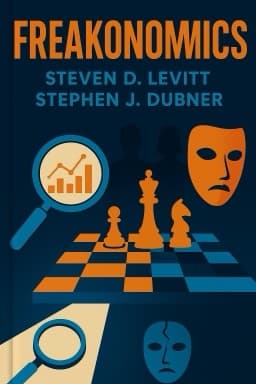
Unlocking Life’s Secrets: How Freakonomics Reveals the Hidden Forces Shaping Our World
Discover the astonishing truths lurking beneath everyday events through the lens of economics and human incentives.

Imagine a world where the tiny nudges of incentives quietly orchestrate the grand symphony of human actions. This is the realm that Freakonomics invites us into — a place where everyday events, from why parents arrive late at day-care centers to the dramatic drop in crime during the 1990s, are explained by the invisible hand of incentives and information.
Consider the story of day-care fines that backfired spectacularly. When a small monetary penalty was introduced to discourage parents from picking up their children late, the number of late arrivals actually doubled. This happened because the fine replaced the moral guilt with a simple economic cost, making lateness a purchasable convenience rather than a social taboo. This example teaches us that incentives must be understood in context — a small change can ripple into unexpected consequences.
Another powerful theme is information asymmetry — the imbalance of knowledge between parties. Real-estate agents, armed with insider knowledge, sell their own homes for higher prices and wait longer than when selling for clients, revealing how knowledge can be leveraged for advantage. Likewise, exposing the secret rituals of the Ku Klux Klan stripped away their aura of fear, demonstrating how transparency can dismantle power structures.
One of the most startling revelations is the explanation for the sharp crime drop in the 1990s. While many credited economic growth or policing, the data points to legalized abortion decades earlier as a major factor. By reducing births among high-risk populations, the pool of potential criminals shrank, leading to fewer crimes years later. This teaches us to look for hidden, delayed causes behind social phenomena.
Cheating is another pervasive theme. From teachers altering test scores under pressure to sumo wrestlers fixing matches, incentives create temptations that many succumb to when the rewards outweigh risks. Yet, data and statistical tools can detect these patterns, offering hope for fairness and accountability.
The economics of illicit markets further reveal surprising parallels with legitimate businesses. Drug gangs operate with clear hierarchies and wage disparities, showing that even illegal enterprises respond to incentives and risk calculations. Understanding these dynamics challenges stereotypes and informs better policy approaches.
Finally, Freakonomics explores how incentives and social norms shape personal choices like naming children, voting, and dating. Social pressures often outweigh direct economic benefits, illustrating the subtle forces guiding our behaviors.
Freakonomics encourages us to embrace complexity, question assumptions, and remain curious. By seeing the hidden side of everything, we gain not only insight but empathy and a richer understanding of the world. This book is a call to look beyond the obvious and discover the fascinating patterns beneath the surface.
Want to explore more insights from this book?
Read the full book summary